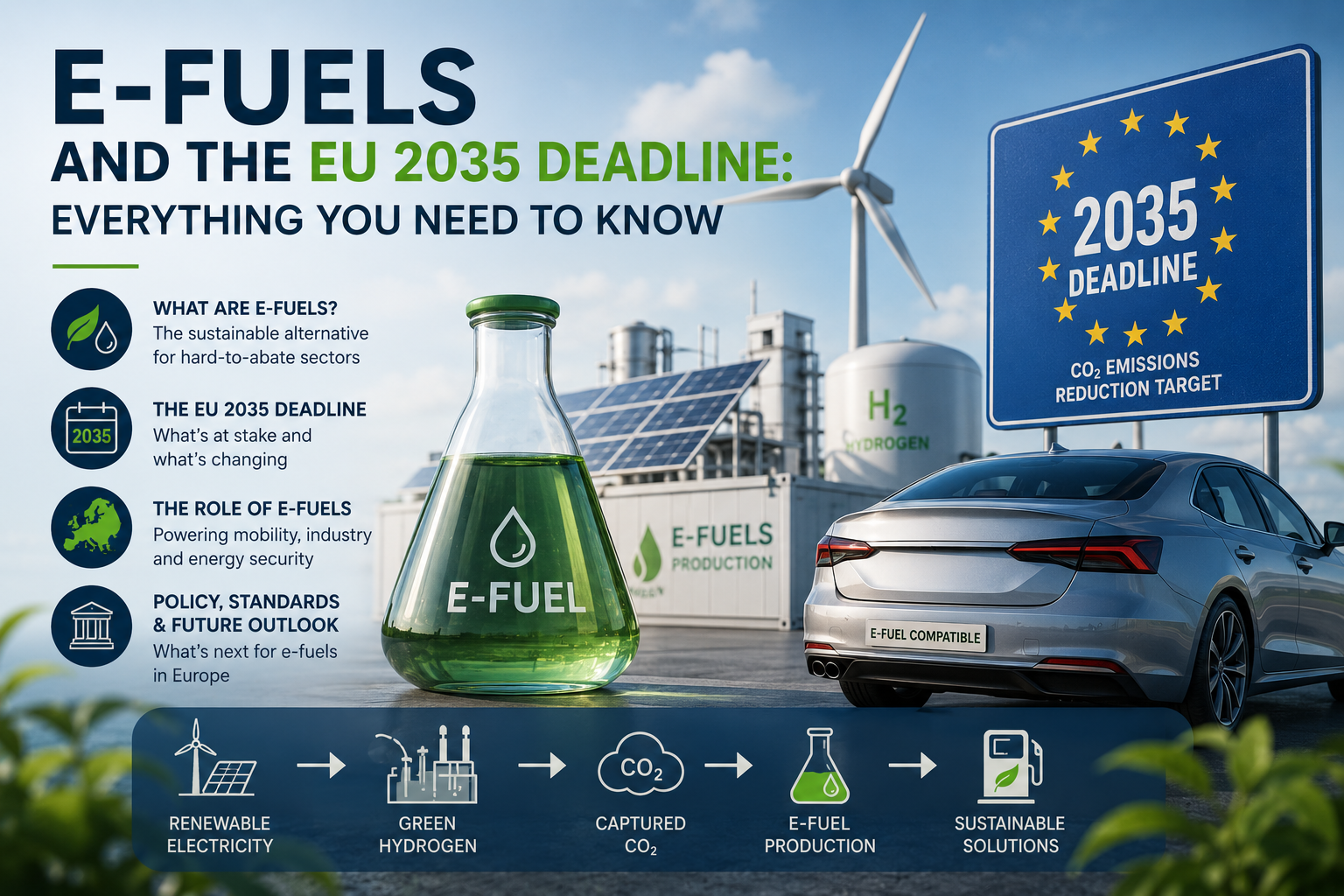
Making petrol out of thin air: the honest beginner’s guide
Why critics say synthetic fuel wastes most of its energy, why they are right about cars, why they are wrong about planes — and what a hole in the ground in Lorraine could change. Explained from scratch, with drawings.
Photo : Unsplash — libre de droits
No chemistry background needed. This guide brings together two more technical articles on this site into one plain-language explanation. If you have ever wondered whether synthetic fuels are a real climate solution or an elaborate distraction, the honest answer is: it depends entirely on what you want to move, and where you make the fuel. Here is why.
STEP 1
What is a synthetic fuel, really?
Ordinary petrol is made of two things: hydrogen and carbon. Nothing else. We normally get both by pumping crude oil out of the ground — carbon that has been locked away underground for millions of years, which we then release into the sky.
A synthetic fuel — an “e-fuel” — is the same molecule, built differently. You take hydrogen from water, carbon from CO₂ already in the air or coming out of a factory chimney, and you assemble them into a liquid. The result is chemically identical to petrol. Same smell, same pump, same engine, same range. Your car cannot tell the difference.
The recipe, in one line
Two ingredients, one assembly step, and a liquid that behaves exactly like petrol.
💡 Why would anyone bother?
Because the carbon in a synthetic fuel was already above ground. Burning it puts back exactly what was taken out, so nothing new is added to the atmosphere. That is the whole idea: a closed loop instead of a one-way trip from underground to sky.
STEP 2
The criticism: you lose most of the energy
Here is where critics have a strong point, and this site accepts it entirely.
Making a synthetic fuel takes many steps, and every step wastes some energy — mostly as heat. Think of passing buckets of water down a line of people: each handover spills a little. With enough handovers, most of the water is gone before it reaches the end.
Now compare the two ways of moving a car with the same kilowatt-hour of wind electricity.
The same electricity, two routes
Start with 100 units of wind electricity. Follow how much actually turns the wheels.
16 against 72. That is roughly four and a half times worse — usually rounded to “five times more electricity for the same journey”. The figure comes from the International Council on Clean Transportation, an independent research body. It is not disputed here.
⚠ What we concede, without argument
For a normal car with a normal charging point, the battery is simply better. Cheaper to run, far less electricity, fewer parts to break. Nobody should be told otherwise, and anyone selling synthetic fuel as the smart choice for the school run is selling something untrue.
STEP 3
So why does anyone still make synthetic fuel?
Because that comparison only works when there are two options to compare. For a lot of the things we move, there is only one.
The reason is weight. Batteries are heavy for the energy they hold — and this is not an engineering problem waiting to be solved. It is chemistry.
One kilogram of each — how much energy is inside
Both bars show one kilogram. Drawn to scale.
A long-haul aircraft carries 100 tonnes of fuel or more. To store that much energy in batteries you would need thousands of tonnes — several times what the aircraft can lift, before adding a single passenger.
✈ The point that gets missed
This is not a claim that synthetic fuel is efficient in an aircraft. It is exactly as wasteful there as in a car. The point is different: on a Paris–Tokyo flight there is no battery to be more efficient than. The real choice is between synthetic kerosene and fossil kerosene — and against fossil kerosene, synthetic wins on carbon every time.
The same applies to ships. A container vessel crossing from Rotterdam to Shanghai cannot carry the batteries either — and neither can long-distance lorries, or the 1.4 billion petrol and diesel cars already on the world’s roads today. · Photo : Unsplash — libre de droits
STEP 4
Where exactly does all that electricity go?
To understand what could improve, you need to know which part of the process is the greedy one. It turns out there are three, and they are very unequal.
Electricity used to make enough fuel for 100 km
The standard way: hydrogen made from electricity, carbon pulled out of the air.
Almost 70% of the electricity goes into making the hydrogen — splitting water apart takes enormous power. Catching CO₂ out of thin air is the second-biggest cost. Actually assembling the fuel is the smallest part.
💡 Remember this, it is the key to everything that follows
If most of the electricity goes into making hydrogen and catching carbon, then anything that supplies those two without electricity changes the whole picture. Hold that thought.
STEP 5
What if you didn’t have to make the hydrogen?
Here is something most people have never heard: the Earth makes hydrogen by itself. Deep underground, certain iron-rich rocks react with groundwater and release hydrogen gas — continuously, and they have been doing it for millions of years. It has a name: white hydrogen, or natural hydrogen.
You do not manufacture it. You drill for it, like gas. And drilling uses a tiny fraction of the electricity that splitting water does.
In June 2026, a French company drilling at Pontpierre in Lorraine found gas containing 49.6% hydrogen at 2,426 metres down — among the highest concentrations ever measured anywhere. They aim to sell it from late 2028 at roughly one-tenth of what manufactured hydrogen costs today. It is not certified yet: an independent assessment is due in 2027. · Photo : Unsplash — libre de droits
And the second greedy step — catching CO₂ — has a cheap version too. Pulling carbon out of open air is hard because air is only 0.04% CO₂. But some factories emit streams that are already 95 to 99% pure CO₂: ammonia plants, bioethanol distilleries. There is nothing to separate. You just dry it, compress it, and send it down a pipe.
Same 100 km — hydrogen from the ground, CO₂ from a pipe
The two greedy steps have almost vanished. Same scale as the previous drawing.
From 142 units down to 23. The gap with an electric car falls from roughly eight times to about one and a third. Nothing about the chemistry changed — the wasteful steps are all still there. What changed is that the energy no longer arrives through the electricity meter.
STEP 6
The bonus nobody counts: the reactor gets hot
One last thing, and it is genuinely surprising.
When hydrogen and CO₂ combine into fuel, the reaction gives off heat — a lot of it. Between a fifth and a quarter of everything going in comes back out as heat, at 200 to 350°C. Every plant already has to remove it, otherwise the reactor overheats. The question is what you do with it next.
That temperature is genuinely useful: it is industrial steam. Pipe it to a neighbouring factory or a district heating network and it replaces gas that would otherwise be burned.
🔥 A twist worth noticing
A plant that makes its own hydrogen has a good use for that heat inside its own fence — it helps run the electrolyser. A plant using hydrogen from the ground has no electrolyser, so all of the heat is free to sell. The apparent disadvantage turns into the opposite — provided somebody nearby actually wants the heat.
THE SCOREBOARD
Everything on one chart
Electricity needed to travel 100 km
Lower is better. Every bar drawn to the same scale.
Read the top bar as the criticism, and the bottom two as what becomes possible in one very specific situation: a natural hydrogen field, next to a factory with pure CO₂, next to somebody who wants steam. Three conditions — and nowhere on Earth has all three today.
⚠ Four things you should hold against this article
These numbers are estimates, not measurements. They are built by stacking several published figures on top of each other. The ranking of the bars is solid. The exact numbers are not, and should not be quoted as if they were.
Nobody produces natural hydrogen commercially yet. How much energy it really takes to get it out of the ground is an educated guess. If it turns out three times harder than assumed, the last bars move.
The Lorraine deposit is not confirmed. An independent assessment is due in 2027. It might confirm it, shrink it, or find it cannot be produced economically. Nothing here assumes the answer.
Using the same electricity is not costing the same money. This article counts kilowatt-hours only. Building the plant, drilling the well, buying the car — all of that is a separate question, and a harder one.
So — good idea or not?
Both, depending on what you are moving.
For your car, if you can plug it in: get the electric one. It uses far less energy, costs less to run, and no clever plumbing changes that. The critics are right and we are not going to pretend otherwise.
For aircraft, ships, long-distance lorries, and the 1.4 billion petrol cars already out there: there is no battery version. The choice is synthetic fuel or fossil fuel, and on carbon, synthetic wins.
And the objection that synthetic fuel eats too much electricity? It is really an objection about one particular way of making it — the way that manufactures hydrogen from electricity and scrapes CO₂ out of open air. Change where those two come from, and the argument has to be made again, on different ground.
Synthetic fuel is not a replacement for the electric car. It is what you use for everything the electric car cannot be.
e-fuels.ai · Beginner’s guide · August 2026
📚 Want the detail?
This guide summarises two longer, more technical articles on this site: one on the efficiency objection and where it applies, and one on heat recovery and pipeline CO₂. Both carry the full figures, the sources, and the caveats in more depth.
→ ICCT — “E-fuels won’t save the internal combustion engine” — 16% e-fuel vs 72% battery-electric, well-to-wheel
→ ICCT — “What to expect when expecting electric airplanes” — battery pack ceiling 400–500 Wh/kg
→ ScienceDirect — Fischer-Tropsch overview — 20–25% of input released as recoverable heat at 200–350°C
→ Energy & Fuels (ACS) — FT plant in cogeneration mode — 63% overall system efficiency with district heating
→ Stanford & Climeworks/Carbon Engineering data — direct air capture 1,500–3,000 kWh per tonne CO₂
→ Sustainability Atlas — high-purity industrial CO₂ streams at $15–25/t vs $30–100/t for dilute flue gas
→ Aerotime — Jet A-1 energy density 43.15 MJ/kg
→ FDE — PTH-2 Lorraine, 49.6% H₂ at 2,426 m — 23 June 2026 — actusnews.com
⚖ Editorial note & disclaimers
Simplifications: this is a beginner’s guide. Figures are rounded and several intermediate steps are omitted for clarity. The per-100 km values are stacked estimates from published unit data, not measurements from an operating plant, and should be read as orders of magnitude.
Weakest assumption: the energy needed to extract geological hydrogen. No commercial field exists, so no operating data are available to check it.
Contingent claims: the €0.50/kg Lorraine target is a company objective, not a certified price. Independent certification is expected in 2027 and may confirm, revise or reject the resource.
⚙ AI Transparency · EU Regulation 2024/1689 (AI Act) · art. 50
This article was produced with the assistance of an artificial intelligence system (Claude, Anthropic). This notice applies to all editorial content on this site, including automatically published content. Informational only — verify official sources before any decision.