
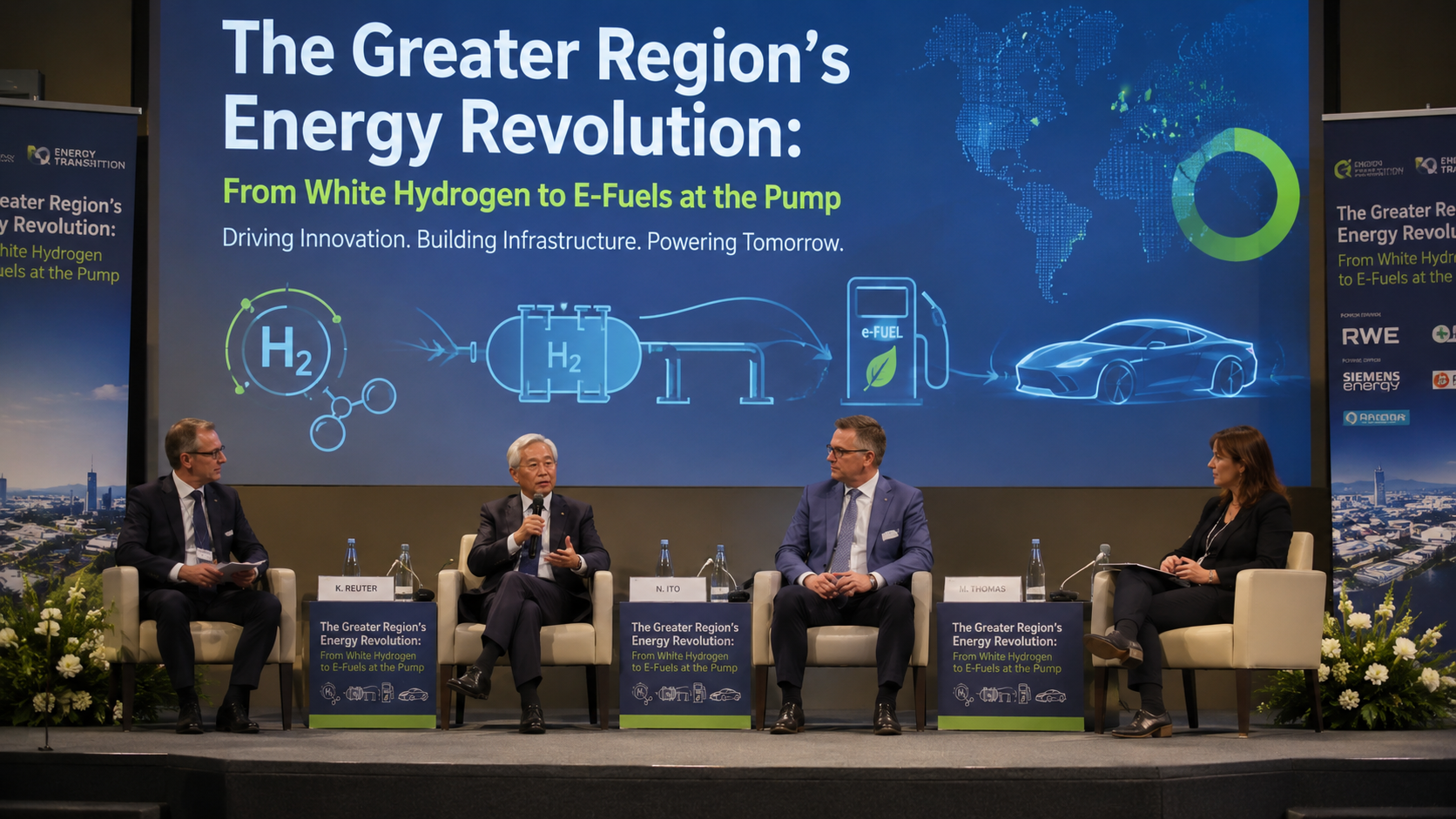
The Greater Region’s
Energy Revolution
From white hydrogen under Lorraine to e-fuels at the pump — how Belgium, Luxembourg, France and Germany are building Europe’s first autonomous synthetic fuel hub
The Convergence That Changes Everything
Separately, each piece is interesting. Together, they form something extraordinary: the first credible pathway to autonomous, locally-produced synthetic fuel in continental Europe — at a price that competes with the petrol pump.
In the space of three years, a series of apparently unrelated developments have begun to converge in the Greater Region — the cross-border area where Belgium, Luxembourg, France and Germany meet. A geological discovery through deep borehole analysis in the Lorraine basin. A Belgian government programme announced this week. A network of planned hydrogen and CO₂ pipelines. A revolutionary engine from a Renault-Geely joint venture. And the quiet but relentless pressure of EU fuel mandates.
Each of these stories has been reported separately. None has been told as a single, connected narrative. This article does exactly that — and what emerges is a scenario that, if it plays out, could make the Greater Region the most strategically important energy territory in Europe by 2035.
The central thesis is simple: natural hydrogen extracted from the ground in Lorraine and potentially Belgium, combined with captured industrial CO₂, converted into synthetic e-fuels in plants located next to the region’s heavy industries, distributed via existing infrastructure — could produce petrol, diesel and aviation fuel at prices competitive with today’s fossil fuels. And the technology to make it happen already exists.

Natural Hydrogen: The Earth Already Made It
The most expensive part of making e-fuels is producing hydrogen. What if the Earth had already done that work — for free — over millions of years?

How the Earth Makes Hydrogen
Deep in the Earth’s crust, a chemical reaction has been occurring for billions of years. When water percolates through iron-rich rocks — peridotite, serpentinite — at temperatures of 200 to 400°C, the iron oxidises and releases molecular hydrogen gas as a byproduct. The chemical equation is elegant in its simplicity:
This process — known as serpentinisation — is continuous. The Earth produces hydrogen constantly, without any human intervention, without any electricity input, without any carbon emissions. The hydrogen migrates upward through permeable rock and either dissolves in groundwater or accumulates in geological traps similar to natural gas reservoirs.
Until 2012, no one had seriously looked for these accumulations in non-volcanic continental Europe. Then two CNRS researchers in Nancy analysed groundwater data from existing deep boreholes in the Lorraine basin — geological surveys originally drilled for coal and gas exploration. What they found changed the conversation.
The Lorraine Discovery
Geologists Jacques Pironon and Philippe De Donato of the GeoRessources Laboratory at the University of Lorraine detected concentrations of hydrogen dissolved in the groundwater of former mines that were far higher than anything expected in a non-volcanic context: 1% hydrogen at 600 metres depth, rising to 17% at 1,100 metres.
A preliminary geological estimate placed the potential deposit at 46 million tonnes of hydrogen. To put this in context: total global green hydrogen production in 2024 was approximately 0.7 million tonnes. The Lorraine deposit — if confirmed — represents 65 years of current global green hydrogen production sitting under a former industrial region in northeast France.
In October 2025, the Française de l’Énergie (FDE) began the REGALOR II deep borehole at Pontpierre in Moselle, drilling to 3,655 metres. Strong hydrogen concentrations were confirmed immediately. In January 2026, the French government published the “Trois Évêchés” exclusive exploration permit — 2,254 km² in Moselle and Meurthe-et-Moselle — the first geological hydrogen exploration permit ever granted in France.
BE.Hydrogen: Belgium’s National Response
On May 27, 2026 — the same day this article is published — the RTBF reported that Belgium has launched a national scientific exploration programme for natural hydrogen, called BE.Hydrogen, coordinated by the Geological Survey of Belgium.


Why Belgium Is Well Placed
Belgium’s geological history makes it a credible candidate for natural hydrogen accumulations. The country shares the same ancient geological formations as Lorraine — the Hercynian basement, former coal-bearing strata, iron-rich ultramafic intrusions in the Ardennes massif.
The former coal basins of Hainaut, Liège and Limbourg — now largely flooded — present exactly the geological conditions that produced the Lorraine discovery: iron-rich rocks, deep groundwater, millions of years of serpentinisation. The Brabant massif in central Belgium offers additional geological complexity.
A first evaluation from the BE.Hydrogen programme is expected in spring 2028. If the results are positive, Belgium could become the second country in continental Europe — after France — with a confirmed natural hydrogen deposit. The political and economic implications for the Greater Region would be transformative.
The geological conditions in southern Belgium share many characteristics with the Lorraine basin where exceptional hydrogen concentrations have been found. We cannot ignore the possibility that similar accumulations exist under Belgian soil.
HY4Link and Fluxys: The Arteries of the New Economy
Natural hydrogen in the ground is worthless without infrastructure to move it. That infrastructure is already being planned — and the Greater Region is at its centre.

HY4Link — The Hydrogen Backbone
HY4Link is a planned cross-border hydrogen transport network developed jointly by Creos Luxembourg, Fluxys hydrogen (Belgium) and NaTran/GRTgaz (France). It is designed to connect industrial hydrogen demand clusters in France, Germany, Belgium and Luxembourg with hydrogen supply centres along the North Sea coast and import hubs in Antwerp, Zeebrugge, Rotterdam and Dunkirk.
HY4Link · Simplified Network Route
The project has been included in the European Hydrogen Network Ten-Year Development Plan — a critical step toward EU Project of Common Interest status, which unlocks European financing. The network will connect to the mosaHYc project via Thionville-Bouzonville, the Belgian Hydrogen Backbone via Bras-Liège, and the H2Med corridor via Nancy-Cerville.
The Fluxys CO₂ Grid — The Other Half of the Equation
E-fuels require two ingredients: hydrogen and CO₂. The hydrogen will come from the ground. The CO₂ must come from industrial emitters. Fluxys — Belgium’s gas infrastructure operator — has been designated as the Licensed CO₂ Network Operator (LCNO) for Belgium, with its c-grid network connecting CO₂ emitters across the Antwerp industrial zone to export terminals.
Natural hydrogen from Lorraine/Belgium extracted via METS degassing technology. Target: €0.50/kg — 9× cheaper than green hydrogen electrolysis today.
Captured from ArcelorMittal Liège, BASF Antwerp, cement plants, steel mills — industries that cannot easily electrify and produce unavoidable CO₂ emissions.
H₂ + CO₂ → synthetic petrol, diesel, jet fuel via Fischer-Tropsch synthesis. Drop-in fuels: compatible with every existing engine and refuelling infrastructure today.
Why E-Fuel Plants Belong Next to Industry
This is the detail that most coverage misses — and it is the detail that makes the Greater Region uniquely suited to e-fuel production. The Fischer-Tropsch synthesis is exothermic. It generates heat. That heat is money — if you know how to use it.

The Power-to-Liquid Process — Step by Step
Natural H₂ extracted from deep borehole via METS degassing technology. Cost target: €0.50/kg vs €4.50/kg for green H₂ electrolysis.
Industrial CO₂ captured from steel plants, cement factories, chemical works. Existing Fluxys c-grid transports it to the synthesis facility.
Reverse Water-Gas Shift converts CO₂ + H₂ into synthesis gas (CO + H₂). This step uses heat from subsequent Fischer-Tropsch reaction — integrated efficiency gain.
Exothermic reaction: CO + H₂ → liquid hydrocarbons. Significant heat released at ~200–350°C. KIT/INERATEC compact reactors recover this heat as steam.
Steam from Fischer-Tropsch → steam turbine → electricity. This recovered energy reduces the net electricity demand of the plant by 20–35%, cutting production costs.
The Critical Insight: Co-Location with Industry
The Fischer-Tropsch synthesis releases heat continuously during operation. In an isolated plant in a remote location, this heat must be dissipated — it is wasted. But in an industrial zone where neighbouring factories need heat and steam, this waste becomes a product.
Research from KIT (Karlsruhe Institute of Technology) — the institution behind INERATEC’s compact reactor technology — confirms that “the heat released during this reaction can be used efficiently: in the Energy Lab, the released reaction heat is used in the form of steam at other points in the process chain, which increases the overall efficiency of the process chain.”
Scientific modelling shows that the best integrated Power-to-Liquid configurations — combining solid oxide electrolysis, Fischer-Tropsch synthesis and heat recovery — can achieve plant efficiencies of up to 81%. Co-location with an industrial consumer that can absorb the recovered heat pushes this further.
ArcelorMittal’s steel plants in Liège and Dunkirk need heat and hydrogen for direct reduction ironmaking. The chemical clusters of Antwerp and Ludwigshafen need low-carbon feedstocks. The cement plants of Wallonia and Saarland need CO₂ capture solutions and heat. The refinery infrastructure at Feluy (TotalEnergies) needs synthetic feedstocks.
Each of these industrial neighbours is simultaneously a CO₂ supplier, a heat consumer, and a potential offtaker for e-fuels. No other region in Europe has this density of compatible industrial neighbours within pipeline distance of a potential natural hydrogen source.
Horse Powertrain: 3.3 Litres per 100 km
The e-fuel revolution needs more than cheap production. It needs an engine efficient enough to make the economics work at the pump. Horse Powertrain — the Renault-Geely-Aramco joint venture — may have just built it.


The H12 Engine — Key Facts
Horse Powertrain’s H12 combustion engine — developed in partnership with Repsol and validated on 100% renewable synthetic fuels — achieves a thermal efficiency of 44.2% running on biofuels, with a claimed fuel consumption of 3.3L/100km under WLTP conditions when used as a range extender in a plug-in hybrid architecture. This represents 40% lower fuel consumption than the 2023 European average for new passenger cars.
The engine is designed to operate exclusively as a generator — it never drives the wheels directly. Instead, it runs continuously in its optimal efficiency band, converting fuel into electricity that powers the electric motor. This “series hybrid” or “range-extended electric vehicle” (REEV) architecture is why the efficiency numbers are so compelling: the engine never has to deal with the variable load conditions that reduce efficiency in conventional hybrid drivetrains.
Horse’s B20 engine achieves an even higher 48.41% thermal efficiency — approaching the theoretical maximum for internal combustion engines. Combined with e-fuels, this architecture offers a pathway to personal mobility that is genuinely competitive with battery-electric vehicles on both efficiency and carbon footprint.
• Naturally aspirated 1.5L four-cylinder engine
• Up to 94 bhp (70 kW) output
• Size: no larger than a briefcase
• Can be installed in frunk or rear of any EV platform
• Compliant with Euro 7 / China 7 / SULEV20
• Designed for petrol, synthetic fuels, ethanol, methanol
• Commercial launch: 2027
• Turbocharged version: 161 bhp for D-segment and commercial vehicles
What this means: Any existing EV platform — Renault, Volvo, Nissan, Geely, Mitsubishi — can be converted to a range-extended hybrid with minimal engineering changes. The range extender adds 600–800 km of additional range, for a total vehicle range of up to 1,000 km.
The Methanol Range Extender — An Alternative Pathway
Horse Powertrain has also developed the D20 Methanol range extender, achieving a methanol-to-electric conversion rate of 2 kWh/L — enabling cold starts at -40°C on pure methanol using high-pressure direct injection. This engine supports any blending ratio of methanol and gasoline (M0–M100), making it compatible with e-methanol produced via Power-to-Liquid using natural hydrogen and CO₂.
E-methanol is currently the cheapest and most scalable Power-to-Liquid pathway — already produced commercially in Iceland, Denmark and Texas. At natural hydrogen costs of €0.50/kg, e-methanol could be produced at €250–350 per tonne, making it cost-competitive with fossil methanol at current carbon price levels.
The Greater Region in 2035: A Story That Could Be Written
This is not a prediction. It is a scenario — a coherent description of what becomes possible if the pieces align. Each element of the following narrative is grounded in technologies and projects that already exist today.

2027 — The Confirmation
REGALOR II results confirm that the Lorraine deposit is commercially viable at scale. The announcement makes front pages from Le Monde to the Financial Times. The French government fast-tracks the exploitation permit. FDE announces a first commercial production facility near Pontpierre. BE.Hydrogen publishes its spring 2028 assessment — three Belgian sub-regions show geological characteristics consistent with natural hydrogen accumulation.
2029–2030 — The Infrastructure Locks In
HY4Link receives its EU Project of Common Interest designation and begins construction. The first segment — Pontpierre to Thionville to Luxembourg — carries natural hydrogen from the Lorraine borehole to the first e-fuel synthesis plant, built adjacent to ArcelorMittal’s partially-converted Liège steel complex. The Fischer-Tropsch plant’s waste heat feeds into the steel mill’s new direct reduction ironmaking process. The mill’s captured CO₂ feeds back into the synthesis plant. A closed industrial loop begins to operate.
2031–2032 — The Products Reach the Market
The first tonnes of e-petrol from the Liège plant enter the distribution network. TotalEnergies, which operates a major refinery at Feluy, blends the synthetic hydrocarbons with its existing products. The first filling stations in Luxembourg and Belgium begin offering certified e-petrol alongside conventional fuel. The price — thanks to natural hydrogen at €0.80/kg and recovered heat revenue — is €1.60–1.90 per litre, approaching price parity with taxed fossil fuel for the first time.
2033–2034 — The Vehicle Fleet Adapts
Renault launches its first production vehicle featuring the Horse C15 range extender, certified to run on e-fuels. The 3.3L/100km fuel consumption means a full tank of e-petrol costs €25–35 for 1,000 km of range — competitive with equivalent battery-electric charging costs in the Greater Region. Volkswagen and Stellantis follow with their own e-fuel compatible hybrid models, all built around the EU 2035 exemption for certified synthetic fuels.
2035 — The Greater Region Hub
Three e-fuel synthesis plants are operational in the Greater Region: one near Pontpierre (Lorraine), one in the Liège industrial valley, one at Feluy (Belgium). Combined production: 800,000 tonnes per year of synthetic fuels — covering approximately 15% of the Greater Region’s total transport fuel consumption. A fourth plant, dedicated entirely to e-SAF for Brussels, Luxembourg and Strasbourg airports, is under construction.
“The Greater Region did not become energy-independent by accident. It happened because the geology was there, the infrastructure was planned before anyone knew it was needed, the industrial base was ready to be repurposed, and the political will — formed by energy crises, geopolitical shocks, and European climate law — finally aligned with the economic opportunity.”
What This Means for the 11 Million People Who Live Here
Each 100,000 tonne/year e-fuel plant creates approximately 400–600 direct jobs in operations, maintenance and logistics — plus 3–5× more in the supply chain.
ArcelorMittal Liège, TotalEnergies Feluy, BASF Antwerp — all transform from carbon liabilities into integrated nodes of the e-fuel production chain, securing their long-term future.
For the first time since the coal era, the Greater Region produces its own energy. No dependence on Russian gas, Middle Eastern oil, or Chinese battery supply chains.
E-fuels from natural hydrogen and captured industrial CO₂ reduce lifecycle CO₂ emissions by 70–90% vs fossil fuels. The region’s carbon footprint falls dramatically without disrupting mobility.
Former mining communities in Lorraine, Wallonia and Saarland — which have waited 40 years for industrial reconversion — find a new economic foundation in e-fuel production.
Brussels, Luxembourg and Strasbourg airports meet their ReFuelEU 6% SAF mandate from 2030 and progress toward 70% by 2050 using locally-produced e-SAF from Greater Region plants.
The Honest Assessment
This scenario is possible. It is not certain. Here is what needs to go right — and what could still go wrong.
What Needs to Go Right
REGALOR II must confirm commercial viability in 2027. If the borehole results show that extraction at scale is technically feasible and economically attractive at below €1/kg, the entire scenario becomes fundable.
BE.Hydrogen must find Belgian reserves. A Belgian deposit would transform the political and financial dynamics — doubling the resource base and anchoring two national governments in the project’s success.
HY4Link must receive EU PCI status and financing. Without the pipeline, the hydrogen cannot reach the synthesis plants cost-effectively.
Horse Powertrain’s engines must reach mass production. The commercial launch of the C15 range extender in 2027 and the H12 hybrid in 2026 must generate the vehicle volumes that create consumer demand for e-fuels.
The EU must maintain the e-fuels exemption for 2035. Political pressure from electric vehicle advocates could weaken or remove this exemption — eliminating the regulatory foundation for e-fuel vehicle sales.
What Could Still Go Wrong
The geology may disappoint. The 46 Mt estimate is preliminary. Deep borehole results may show lower concentrations, difficult extraction conditions, or reservoir depletion rates that make commercial production unviable.
The cost projections may be optimistic. Achieving €0.50/kg for natural hydrogen requires technologies — particularly the METS degassing system — that have not yet been validated at industrial scale.
Regulation may shift. The EU 2035 e-fuels exemption is politically contested. A change in Commission priorities could remove the regulatory certainty that underpins investment decisions.
Competition may be faster. If battery technology improves faster than expected, or if green hydrogen costs fall more rapidly, the economic case for natural hydrogen e-fuels may be overtaken before infrastructure is in place.
The question is not whether synthetic fuels will play a role in Europe’s energy future. ReFuelEU mandates ensure they will. The question is where they will be produced, and who will capture the industrial and economic value of that production. The Greater Region has a once-in-a-generation opportunity to answer that question on its own terms.
CNRS/GeoRessources · Pironon & De Donato (University of Lorraine) · FDE/REGALOR II · Journal Officiel FR Jan. 2026 · RTBF May 27, 2026 (BE.Hydrogen) · Fluxys HY4Link official · Creos Luxembourg · NaTran/GRTgaz · KIT Energy Lab / INERATEC · Horse Powertrain official (Auto China 2026, IAA 2025) · EV Central · Autocar · New Atlas · ScienceDirect Fischer-Tropsch efficiency studies · Norsk e-Fuel technology · ReFuelEU Aviation EU 2023/2405 · EU 2035 e-fuels exemption · IATA SAF Monitor 2026
Disclaimer: Documentary and editorial content. Not investment advice. BESS Energie SRL · BCE 0698.949.732 · Heusy (Verviers), Belgium · info@bess.be · e-fuels.ai