

Let us do the arithmetic properly
The three changes are real, and each is significant. Take them one at a time.
Hydrogen from the ground rather than the electrolyser. Green hydrogen requires roughly 50–55 kWh of electricity per kilogram produced. Geological hydrogen is synthesised by the Earth; the energy cost reduces to drilling, separation and compression. The electrical burden of the hydrogen step falls by roughly an order of magnitude.
CO₂ from a pipe rather than from the air. Direct air capture consumes 1,500–3,000 kWh per tonne of CO₂, because air is 0.04 % CO₂. Certain industrial streams — ammonia plants, bioethanol distilleries — emit gas that is already 95–99 % pure. Nothing needs separating; the cost falls to drying, compression and transport.
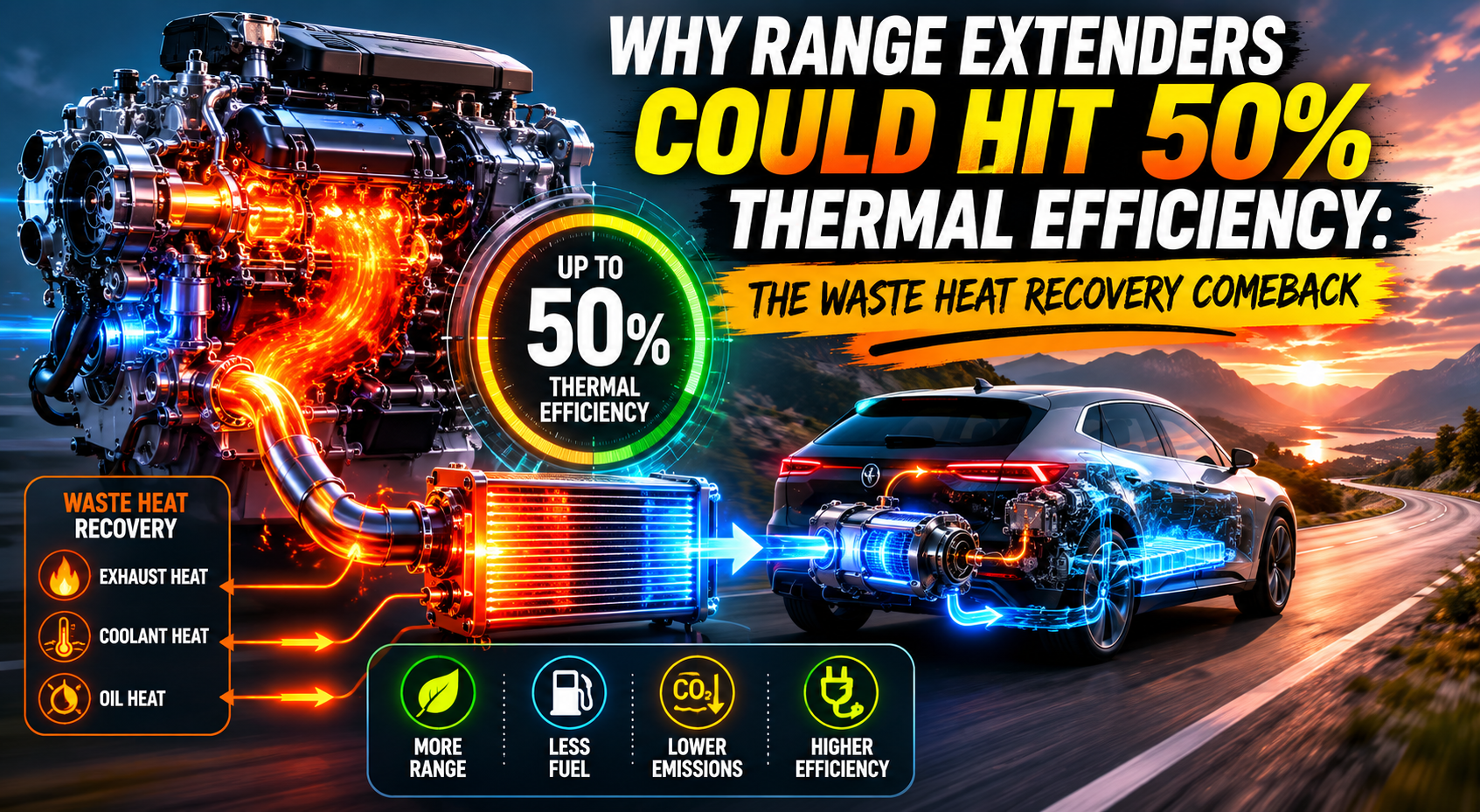
A fixed-speed engine rather than a variable-load one. A conventional engine spends most of its life away from its efficient operating point. A range extender drives a generator at one fixed speed, at peak brake thermal efficiency, while an electric motor turns the wheels. The HORSE H12, unveiled in February 2026, measures 44.2 % peak thermal efficiency on 100 % renewable petrol; the D20 Methanol REEV is announced at 47 % fuel-to-energy.
0.95 (extraction) × 0.98 (pipeline CO₂) × 0.70 (synthesis) × 0.45 (range extender) × 0.90 (drivetrain) = 0.26Roughly 26 %, not 65 %. The error usually comes from crediting exothermic heat recovery as an efficiency gain in the synthesis step. It is not. Fischer-Tropsch releases 20–25 % of the syngas heating value as heat at 200–350 °C, and that heat is genuinely useful — but it leaves the reactor and goes somewhere else. It does not raise the chemical conversion efficiency above what thermodynamics allows.
So the honest figure is around 26 %, against roughly 16 % for the conventional e-fuel chain and 72 % for a battery-electric vehicle. A clear improvement, and still well short of the battery.
Why that number answers the wrong question
Here is the part worth understanding. Well-to-wheel efficiency measures output energy divided by input energy. It is the right metric only when the input is scarce.
Ask why a 26 % ratio matters. The honest answer is: because the thing being lost is expensive. Wasting three quarters of a scarce, contested, expensive input — renewable electricity — is a serious objection. Wasting three quarters of energy that arrives through a wellhead is a different proposition.
When most of the energy enters the chain through geology rather than through the electricity meter, the ratio survives but stops measuring anything anyone pays for.
Electricity per 100 km the comparison that holds
Basis: a range-extender vehicle consuming the equivalent of 3.3 litres per 100 km — the figure announced for the HORSE H12 under WLTP — requiring roughly 1 kg of hydrogen and 7.7 kg of CO₂.
| Configuration | Per 100 km | vs BEV |
|---|---|---|
| Conventional e-fuel: electrolysis + direct air capture | ~142 kWh | ×8.9 |
| With geological hydrogen, DAC retained | ~53 kWh | ×3.3 |
| With geological hydrogen + pipeline CO₂ | ~23 kWh | ×1.4 |
| The above, with synthesis heat sold to a nearby consumer | ~18 kWh | ×1.1 |
| Battery-electric vehicle, 2035 | 14–16 kWh | reference |
Grid losses, on the electricity side. They are already counted. The 72 % battery figure is a well-to-wheel value: transmission, distribution and charging losses are inside it, not outside. In Belgium and France they run at roughly 5–8 % between generation and meter. Adding them again would be double counting.
Fuel haulage, on the e-fuel side. A road tanker carries around 30 tonnes of liquid fuel — roughly 360,000 kWh of chemical energy — over distances of a few hundred kilometres. The energy spent moving it amounts to well under 1 % of the energy delivered. Adding it moves the chain from 26 % to about 25.7 %, and the 18 kWh per 100 km to 18.2.
The asymmetry is worth noticing. A liquid carrying 43 MJ/kg is cheap to move relative to what it contains; a grid loses energy continuously to resistance whether it is carrying much or little. Energy density is not only a constraint that keeps batteries out of aircraft — it is also a logistical advantage on the ground.
Parity, not victory. The efficiency ratio is unchanged — still around 26 % — but the electricity consumption converges with a battery vehicle. Two of the three large electrical loads have left the chain, and part of the third is recovered as saleable heat.
What this does not establish
2. Everything favourable depends on the address. Pipeline CO₂ requires a near-pure industrial source within reach. Selling the synthesis heat requires a buyer within reach. A plant with neither falls back to the 53 kWh row. This is a case for specific plants in specific places, not for synthetic fuel in general.
3. The HORSE H12 is a concept engine, shown in February 2026, not a production model. 44.2 % is peak brake thermal efficiency, not an average over a driving cycle — though a range extender spends far more of its life near that point than a conventional engine does.
4. Equal electricity is not equal cost. This counts kilowatt-hours only. Drilling wells, building synthesis plants, laying CO₂ pipelines — none of that is here, and all of it decides whether any of it happens.
What it does change
Not the case for replacing electric cars. For a passenger car with reliable access to a charging point, the battery remains the better technology — more efficient, cheaper to run, simpler. That has not changed and this analysis does not challenge it.
What changes is narrower and, we think, more useful: the electricity argument against synthetic fuels turns out to be an argument about one particular production configuration — the one that manufactures hydrogen from electricity and scrapes carbon out of open air.
Change where those two inputs come from, and the objection has to be made again on different ground. That ground is cost: capital expenditure, hydrogen price, CO₂ price, vehicle price. Which is a harder argument, and a different article.
Efficiency is a proxy for scarcity. When the scarce resource is renewable electricity, the ratio decides everything. When the hydrogen comes out of the ground, the ratio still measures a loss — but no longer one that anybody has to pay for in gigawatt-hours.
The sectors where this matters most are not passenger cars in any case. Long-haul aviation, deep-sea shipping and heavy long-distance freight have no battery alternative to be less efficient than — and there, a chain at 26 % competes with fossil kerosene and fossil bunker fuel, not with a battery.
Nature of the figures. The per-100 km values are stacked estimates assembled from published unit data, not measurements from any operating installation. They are offered as orders of magnitude and to establish a ranking between configurations, not as reference figures.
Weakest assumption. The energy required to extract, separate and compress geological hydrogen. No commercial field exists anywhere, so no operating data are available to verify it.
Contingent claims. FDE’s Lorraine production target is a declared company objective, not a certified outcome. REGALOR II certification is expected in 2027 and may confirm, revise or fail to confirm the resource. The HORSE H12 is a concept, not a production vehicle.
Informational only. Not investment, legal or commercial advice. © 2026 BESS Energie SRL · BCE 0698.949.732 · e-fuels.ai