
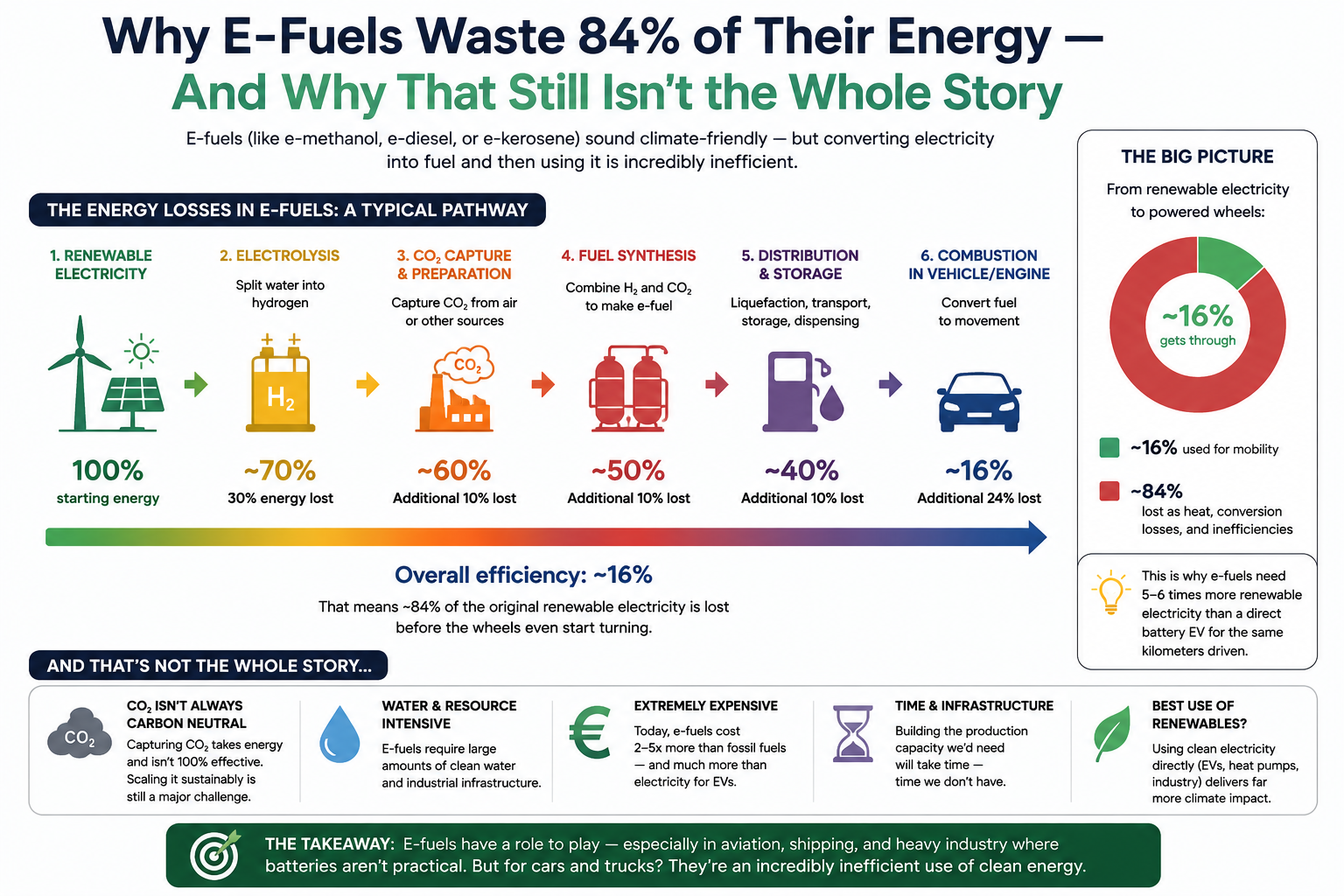

Step one: follow one kilowatt-hour from the wind turbine to the wheels
The clearest way to understand the objection is to take a single kilowatt-hour of renewable electricity and watch what happens to it on each of the two routes. Every arrow in an energy chain has a cost. The question is simply how many arrows there are.
| Wind turbine output |
100% | |
| Electrolysis H₂O → H₂ |
70% | |
| CO₂ capture + synthesis |
56% | |
| Refining + transport |
48% | |
| Combustion engine |
16% |
| Wind turbine output |
100% | |
| Grid transmission |
95% | |
| Charging + battery |
86% | |
| Electric motor |
72% |
Put side by side, 16% against 72%. That ratio — roughly a factor of four and a half, often rounded to “five times more electricity” — is the entire objection. It comes from the International Council on Clean Transportation; the peer-reviewed engineering literature reaches 13% against 73% by the same method. Transport & Environment uses it to argue that supplying even a tenth of new car demand with e-fuels would consume an implausible share of Europe’s renewable build-out.


For a passenger car with reliable access to a charging point, the battery is the better technology. More efficient, cheaper to run, and it will stay that way. No plausible improvement in electrolyser efficiency or synthesis yield closes a gap of that size.
Where e-fuels are promoted as a general-purpose replacement for electrification in road transport, the criticism is correct and the promoters are wrong. Readers should treat any source that omits this — including, until now, parts of this site — with appropriate scepticism.
Step two: the question the ratio cannot answer
An efficiency comparison answers “which of these two should I choose?” It says nothing at all about situations where there is only one option on the table. That distinction is where most of this debate goes wrong.
Aviation is the clearest case, and the reason is physics rather than policy. Energy density — how much energy fits in a kilogram — is not something engineering improves incrementally. It is a property of chemistry.
| 43.15 MJ/kg · Jet A-1 | |
| 0.9 MJ/kg · Li-ion best |
The same reasoning governs deep-sea shipping, long-distance heavy freight, industrial process heat above roughly 800°C, off-road and remote equipment beyond the reach of any grid, and the roughly 1.4 billion combustion vehicles already on the world’s roads — which will not be replaced for decades, and which drop-in synthetic fuel can decarbonise without waiting for fleet turnover.
It is worth noting that the ICCT, which produced the 16% figure, explicitly endorses battery-electric aircraft for commuter flights of 9 to 19 passengers under 200 kilometres. The disagreement is not about whether batteries work. It is about range.

| → | Short distance, grid access — the battery wins on efficiency and on cost. Not a close call. Policy should back electrification. |
| → | Energy density is the binding constraint — long-haul aviation, deep-sea shipping, heavy long-distance road freight. Batteries are not a slower option here; they are not an option. |
| → | The installed fleet — 1.4 billion existing combustion vehicles. Drop-in synthetic fuel decarbonises them today, without scrapping anything. |
| → | High-temperature industry — process heat above ~800°C that direct electrification cannot economically deliver. |
| → | Seasonal storage — surplus summer renewables stored chemically, recovered in winter. Round-trip efficiency is poor. It is still better than curtailing the generation entirely. |
Step three: the hidden premise in the objection itself
Here is the point both sides tend to skip. Ask why a 16% efficiency matters, and the honest answer is: because the thing you are losing is expensive. Wasting 84% of a cheap and abundant input would be untidy but tolerable. Wasting 84% of scarce renewable electricity is a serious argument.
The efficiency objection is therefore, at bottom, an argument about the cost of electricity. Every credible version of it — the ICCT’s, T&E’s, the academic literature’s — rests on that premise, usually without stating it.
Hydrogen accounts for roughly 55% of the production cost of a synthetic fuel. Made by electrolysis at today’s €3–6 per kilogram, the objection holds with full force. But electrolysis is not the only way to obtain hydrogen.

Efficiency is a proxy for scarcity. When the scarce resource is renewable electricity, the ratio decides everything. When the hydrogen comes out of the ground, the ratio still measures a loss — but no longer one that anybody has to pay for in gigawatt-hours.
What would prove this article wrong
Intellectual honesty requires naming the conditions under which the argument above fails. Three would do it.
One. If REGALOR II certification does not confirm a commercially recoverable Lorraine resource in 2027, the €0.50/kg premise collapses and the efficiency objection reasserts itself at full strength. Two. If natural hydrogen turns out to be geographically rare rather than widespread — a genuinely open question, which the European Commission’s Getech mapping programme across all 27 member states is designed to answer by 2027 — the pathway stays niche. Three. If battery specific energy reaches 1,500 Wh/kg at pack level, the aviation argument weakens considerably, although no credible roadmap currently shows that before 2050.
Readers should hold this publication to those conditions.
The honest summary
| Question | Honest answer |
|---|---|
| Are e-fuels efficient? | No. 16% well-to-wheel against 72% for battery-electric. Settled. |
| Should they replace EVs in cities? | No. The battery is better on efficiency, cost and infrastructure. |
| Needed for long-haul aviation? | Yes. 43 vs 0.9 MJ/kg leaves no alternative at that range. |
| Needed for deep-sea shipping? | Yes, as e-methanol and e-ammonia. FuelEU Maritime assumes it. |
| Can they decarbonise today’s fleet? | Yes. Drop-in compatibility is their strongest practical property. |
| Is the cost objection valid today? | Yes, at €3–6/kg hydrogen. Contingent, not permanent. |
| Does natural hydrogen change this? | Potentially and substantially — pending 2027 certification. Not proven. |
Nothing here requires abandoning the case for synthetic fuels. It requires making that case where it holds and conceding it where it does not. A publication that never states the principal objection to its own subject is not a reference source; it is advocacy, and readers are right to discount it accordingly.
The efficiency critics have won the argument about cars. They have not won the argument about aircraft, ships or the 1.4 billion vehicles already on the road — because in those sectors the comparison they rely on has no second term. And the economic force of their objection rests on a premise, expensive hydrogen, that Lorraine may or may not overturn in 2028.
Why this article exists: it was written in direct response to external criticism that this publication systematically omitted the energy-efficiency objection to synthetic fuels. That criticism was well founded. The efficiency figures above are those used by the critics, reproduced without adjustment.
Contingent claims: FDE’s €0.50/kg target is a declared production objective, not an independently certified price. REGALOR II certification is expected in 2027 and may confirm, revise or fail to confirm the Lorraine resource. Nothing here assumes that outcome.
Conversion-step percentages in the two cascade diagrams are indicative and rounded for clarity; they illustrate published end-to-end figures (16% and 72%) rather than any single plant’s measured performance. Real installations vary with technology, siting and electricity source.
Informational only. Not investment, legal or commercial advice. Consult primary sources before any decision. © 2026 BESS Energie SRL · BCE 0698.949.732 · e-fuels.ai