
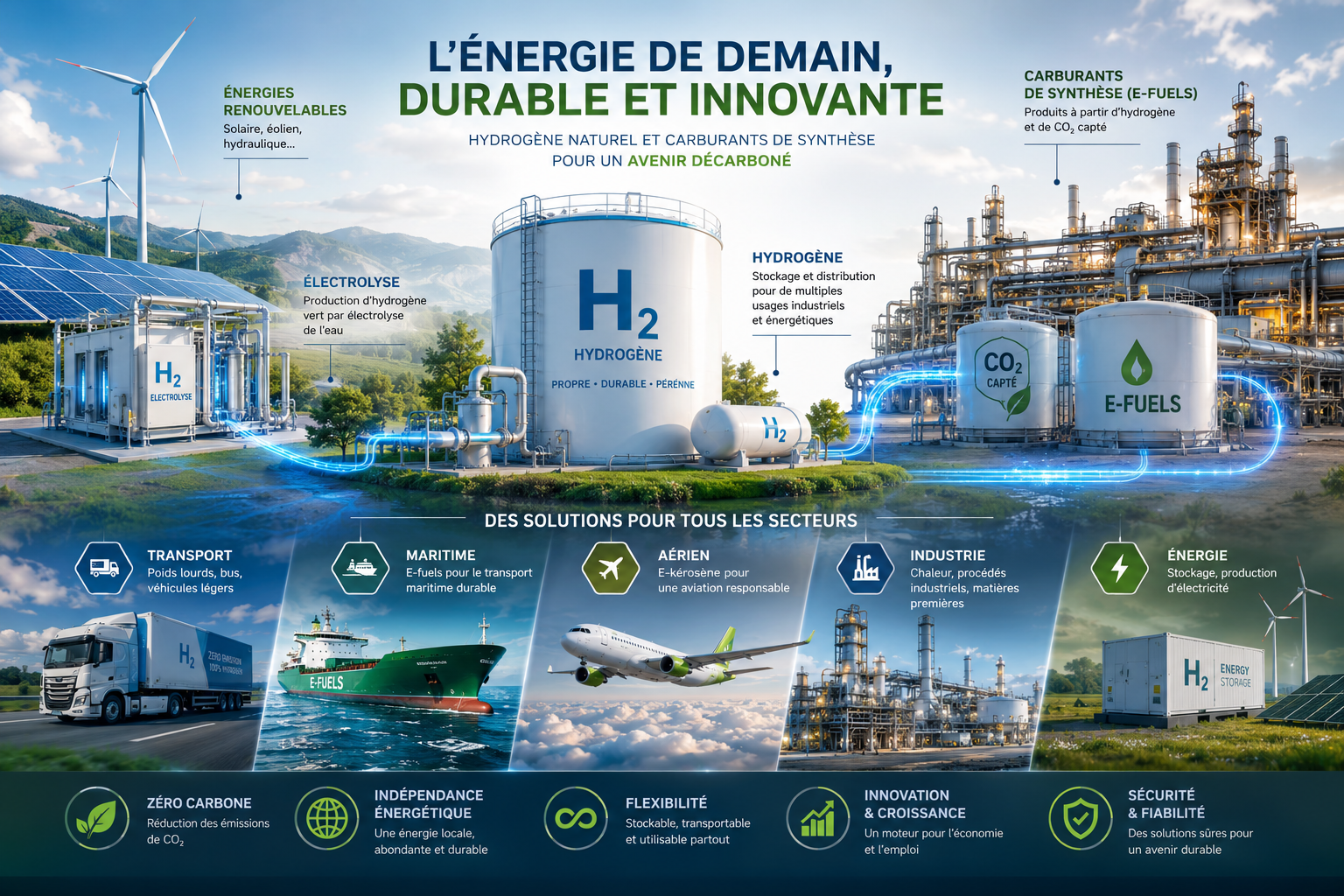

Why Europe’s Grid Cannot Handle 300 Million EVs —
and Why E-Fuels Will Fill the Gap
Three separate developments have converged in the first half of 2026 that, taken together, reshape the long-term outlook for synthetic fuels more fundamentally than any single regulatory decision. Natural hydrogen confirmed at near-record concentrations in Lorraine. Horse Powertrain’s H12 engine certified at 3.3L/100km on 100% renewable fuel. And a growing consensus among grid operators that full electrification of European road transport is physically incompatible with current and near-term electrical infrastructure. This article examines how these three factors interact — and what they mean for the e-fuels sector.
The Grid Problem — A Physical Constraint, Not a Political One
The case against full battery electrification of road transport is not primarily political, even if it has become politically contested. It is physical. Europe’s electrical grid — built over decades to supply industry, heating and lighting — was not designed to simultaneously charge several hundred million vehicles. The numbers are straightforward and not disputed by grid operators themselves.
A battery electric vehicle with a 60–80 kWh pack, fast-charged at 150 kW, draws power equivalent to roughly 75–100 households. A simultaneous Friday evening departure rush — the kind that happens every summer across France, Belgium, Germany and the Netherlands — would create demand spikes of a magnitude that existing high-voltage infrastructure cannot absorb. RTE (France) and Elia (Belgium) have both published studies acknowledging that full electrification requires grid investment in the hundreds of billions of euros over two to three decades.
This is not an argument against electric vehicles for urban daily use — they remain significantly more energy-efficient per kilometre than combustion vehicles running on any fuel, including e-fuels. It is an argument about scale and timeline. The transition to 100% battery EVs as a universal transport solution runs into a wall of infrastructure that does not and cannot exist by 2035.
- Peak demand concentration — simultaneous fast charging in holiday periods creates instantaneous demand spikes incompatible with existing transformer capacity
- Rural infrastructure gap — high-voltage line reinforcement in low-density areas costs disproportionately more and takes longer to permit and build
- Dunkelflaute risk — periods of low wind and low sun in winter create supply gaps that cannot be covered by renewable intermittency alone
- Apartment dwellers — an estimated 40–50% of European households have no access to home charging; public charging infrastructure is insufficient and slow to deploy
- Emerging markets — Central and Eastern Europe, much of Latin America, Africa and India cannot replicate Western European grid density on any realistic timeline
The Liquid Battery Argument — E-Fuels as Grid Buffer
The energy policy insight that changes the calculus is this: synthetic liquid fuels are, in effect, a form of electrical energy storage. When solar and wind generation exceeds grid demand — as it increasingly does on spring afternoons across Germany, Denmark and Spain — that surplus electricity can be used to produce green hydrogen by electrolysis, which is then combined with captured CO₂ to produce e-fuels. The liquid fuel stores the energy for weeks or months, and releases it through the existing petrol station network when needed.
This means that e-fuels do not compete with the electrical grid — they complement it. Instead of requiring billions in new copper cables, transformers and grid reinforcement, e-fuels allow surplus renewable energy to be transported and stored in tanker trucks and underground petrol station tanks that already exist. The infrastructure investment required is a fraction of what full grid electrification demands.

The Lorraine Factor — When H₂ Costs €0.50/kg, the E-Fuel Economics Change
The most significant development for the e-fuels sector in the first half of 2026 was not regulatory. It was geological. On 23 June 2026, Française de l’Énergie (FDE) announced confirmed natural hydrogen concentrations of 36.1% at 2,242 metres and 49.6% at 2,426 metres in its PTH-2 borehole at Pontpierre, Moselle — among the highest natural H₂ concentrations ever measured in situ anywhere on Earth. PTH-2 is currently the world’s deepest well drilled exclusively for natural hydrogen exploration, at 3,655 metres.
FDE CEO Antoine Forcinal stated: “We are no longer discussing a scientific hypothesis; we are progressively de-risking what could become one of Europe’s first industrial-scale natural hydrogen projects.” The company has announced first commercial production for late 2028 or early 2029, with independent resource certification targeted for 2027. Teréga Solutions, one of France’s major gas transport network operators, is already conducting feasibility studies for production and distribution infrastructure.
The economic implication for e-fuels is direct. Hydrogen represents 70–80% of the production cost of any synthetic liquid fuel. Green electrolytic hydrogen currently costs €6–12/kg. The target extraction cost for natural geological hydrogen in Lorraine is approximately €0.50–1.00/kg. At €0.50/kg, the production cost of e-petrol falls from approximately €3.40/L today to roughly €1.60–1.80/L — approaching pump parity with fossil petrol, and below fossil petrol when EU ETS carbon costs are included.
| Fuel Type | H₂ Feedstock | H₂ Cost | E-Petrol Production Cost | vs Fossil Pump |
|---|---|---|---|---|
| Current e-fuels | Electrolytic green H₂ | €6.20/kg | ~€3.40/L | ×2.1 — not competitive |
| If REGALOR II confirmed | Natural H₂ · Lorraine | ~€1.00/kg | ~€2.00/L | ×1.2 — near parity |
| Optimistic 2028–2029 | Natural H₂ at target cost | €0.50/kg | ~€1.60/L | Competitive with ETS carbon price |
The Horse Powertrain Factor — Half the Fuel Consumption Doubles the Argument
The standard efficiency objection to e-fuels goes as follows: because synthetic fuels are burned in combustion engines with 35–40% thermal efficiency, while battery EVs convert electricity to motion at 85–90% efficiency, the “well-to-wheel” energy loss for e-fuels is substantially higher. This is a valid point and should not be dismissed.
Horse Powertrain — the joint venture of Renault and Geely, with Aramco holding a 10% stake — announced in February 2026 the H12 Concept engine: a 1.2-litre 3-cylinder hybrid optimised for 100% renewable fuels, achieving a WLTP consumption of 3.3L/100km and a thermal efficiency of 44.2% — among the highest ever recorded for a petrol engine. The engine uses a 17:1 compression ratio and high-energy ignition, and is specifically designed to run on e-fuels and bioethanol blends.
The efficiency gap between e-fuels and battery EVs narrows significantly when the combustion engine consuming the fuel operates at 44% thermal efficiency rather than the historical 35–38%. A vehicle consuming 3.3L/100km of e-fuel produced from natural hydrogen at €0.50/kg arrives at a cost-per-kilometre that is genuinely competitive with a battery EV for a driver without home charging access.
If e-fuel costs twice as much as fossil petrol at the pump, but the engine consumes half the fuel of a standard combustion vehicle, the cost-per-kilometre remains identical. For 300 million existing vehicles and 40–50% of European households without home charging, this is not a marginal argument — it is the argument.
e-fuels.ai · Editorial · June 2026The Range-Extender Architecture — Small Battery + E-Fuel = No Anxiety
Horse Powertrain’s C15 “suitcase engine” — named for its dimensions of 48×49×25cm — takes a different approach. Rather than driving the wheels directly, it functions as an onboard generator: a compact 4-cylinder running at constant optimal RPM to recharge a small 15–20 kWh battery. The vehicle drives on electricity for daily urban use, then the generator starts only when the battery needs recharging on long journeys.
This architecture eliminates range anxiety without requiring a large, expensive battery pack. It charges overnight on a standard domestic socket (2.3–3.7 kW — no fast charger, no grid stress). For long journeys, the driver stops at any existing petrol station for three minutes, fills with e-fuel, and continues. The grid impact is minimal. The infrastructure investment is zero.
Saudi Aramco’s decision to take a 10% stake in Horse Powertrain alongside Renault (45%) and Geely (45%) is not sentiment. Aramco’s projections hold that more than half of the global vehicle fleet will still be running on combustion or hybrid powertrains in 2050 — not because electrification fails in Western Europe, but because it cannot be replicated at the required speed and cost across Latin America, Africa, India and large parts of Asia. For those markets, the e-fuel + efficient combustion engine is the transition pathway that does not require rebuilding the energy infrastructure from scratch.

The Honest Assessment — What This Does Not Solve
An honest analysis requires naming the limits of this convergence thesis.
Natural hydrogen confirmation is pending, not complete. PTH-2 confirms exceptional concentrations — but flow rates, reservoir permeability and long-term production performance are not yet confirmed. The SYSPROG™ measurements planned for H2 2026 and the independent resource certification targeted for 2027 are decisive gates. Environmental permitting in France carries additional risk of delay.
The efficiency gap remains real for urban users with home charging. A driver who charges overnight on a domestic socket and covers 30km per day will always have a lower cost-per-kilometre in a pure battery EV than in any combustion vehicle running on any fuel, including e-fuels from natural hydrogen. The e-fuels + efficient engine thesis is most compelling for rural users, long-distance drivers, emerging markets, and the approximately 300 million existing vehicles that cannot be replaced before 2035.
Scale-up takes time. Even if REGALOR II is certified in 2027 and production begins in 2028–2029, scaling from first production to the volumes needed to supply European road transport takes additional years and billions in infrastructure investment. The 2035 deadline is tight.
- PTH-2 results (June 2026) — natural H₂ at near-record concentration confirmed in Lorraine; industrial timeline announced for 2028
- Horse H12 certified (February 2026) — 3.3L/100km on 100% renewable fuel; 44.2% thermal efficiency; designed for e-fuels
- EU 2035 e-fuels exemption — combustion engines running exclusively on e-fuels remain legal after 2035; this is law, not proposal
- ReFuelEU Aviation (2025) — e-kerosene mandated; demand for e-SAF is regulatory, not optional
- FuelEU Maritime (2025) — e-methanol and e-ammonia mandated for shipping; 2× credit for green ammonia through 2033
- Grid constraint reality — RTE, Elia and major European grid operators acknowledge full electrification requires infrastructure investment that cannot be completed by 2035