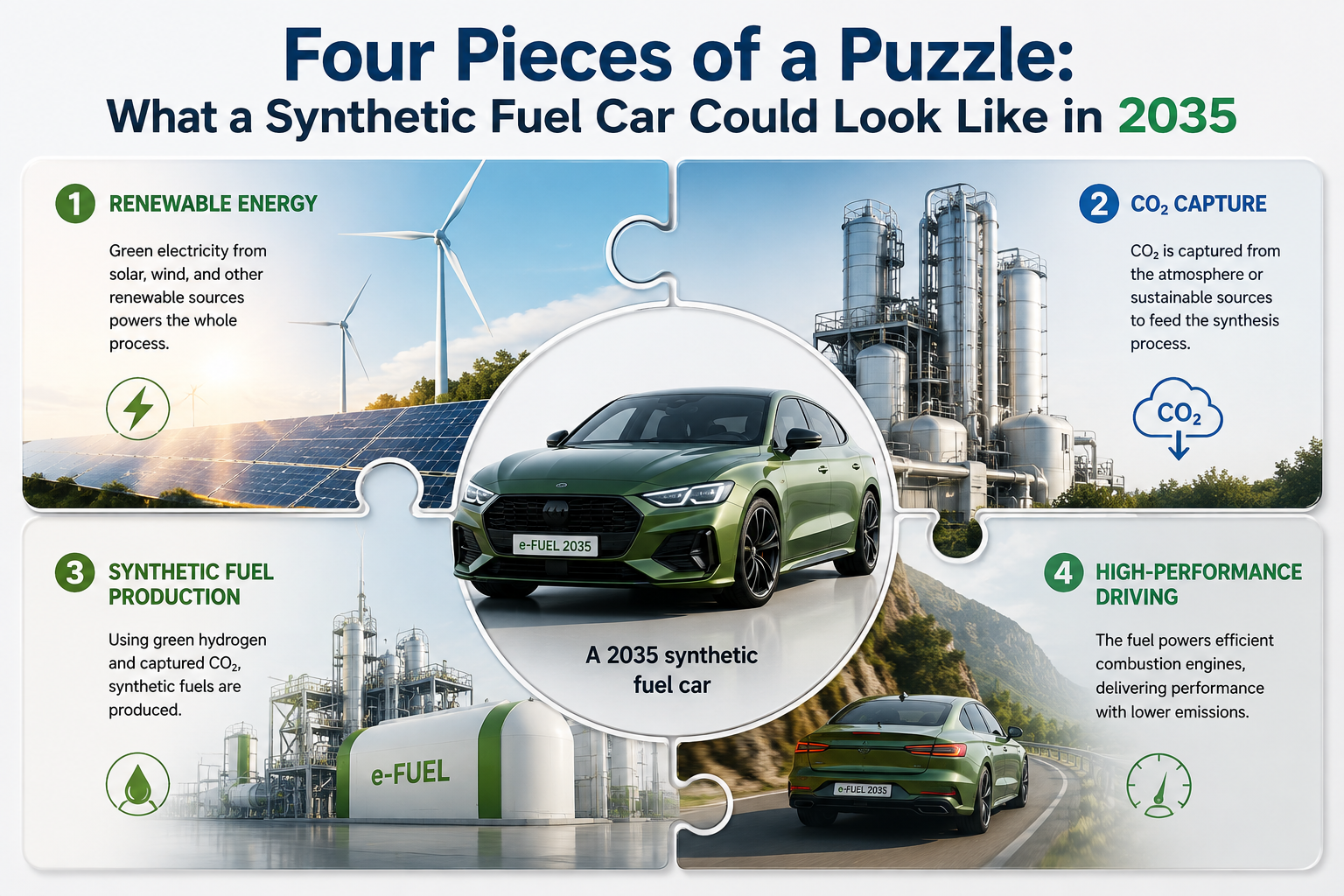
Four pieces of a puzzle: what a synthetic fuel car could look like in 2035
Hydrogen drilled from rock. Carbon arriving by pipe. An engine the size of a suitcase running at 44% efficiency. And the factory next door buying the waste heat. We add it up — and say honestly where the estimate could be wrong.
Photo : Unsplash — libre de droits
This is a thought experiment, not a forecast. We take four developments that exist today — some as working hardware, some as a hole in the ground — and ask what happens if all four land together by 2035. The answer is more interesting than we expected, and the uncertainty is larger than the answer. Both are stated here.
THE SETUP
The four pieces
Everything below rests on four things. Three of them exist today in some form. One does not exist yet at all.
Piece 1 · exists as hardware
The suitcase engine
A 1.2-litre hybrid engine unveiled in February 2026 that reaches 44.2% efficiency and burns under 3.3 litres per 100 km. Small enough to sit in a corner of the car and just generate electricity.
Piece 2 · found, not yet produced
Hydrogen from rock
Gas containing 49.6% hydrogen, found at 2,426 metres under Lorraine in June 2026. Made by the Earth, not by a factory. Production targeted for late 2028 — if an independent assessment in 2027 confirms it.
Piece 3 · exists, widely used
Carbon by pipeline
Some factories emit gas that is already 95–99% pure CO₂ — ammonia plants, bioethanol distilleries. Nothing to separate. Dry it, compress it, pipe it. This is where industrial CO₂ already comes from today.
Piece 4 · standard practice
Heat to the city
Making the fuel releases a fifth of its input as heat at 200–350°C. Every plant already removes it. Pipe it to a district heating network and it replaces gas that would otherwise be burned.
PIECE 1
The engine that fits in a suitcase
Start with the car, because this is the piece most people have not heard about.
A conventional engine has to do everything: pull away from traffic lights, climb hills, cruise at 130 km/h. It spends most of its life running at speeds where it is inefficient. That is a large part of why petrol cars waste so much.
A range extender works differently. The wheels are driven by an electric motor, always. The petrol engine never touches them — it only turns a generator, and it does so at one single speed, the one where it is most efficient. It can be small, simple, and it can live at its sweet spot permanently.
Two ways to use a petrol engine
Same fuel, very different amount of time spent at peak efficiency.
The HORSE H12, shown in Madrid in February 2026, is a 1.2-litre unit with a 17:1 compression ratio built for exactly this job. Its makers — a Renault–Geely joint venture, working with Repsol — measured 44.2% peak efficiency, a figure normally associated with large diesel engines. It is designed to run on 100% renewable petrol.
⚠ One word matters: peak
44.2% is the best point of the engine, not its average over a journey. In a normal car that distinction matters enormously, because the engine spends little time there. In a range extender it matters much less — that is the entire reason for the layout. But “peak” is not “always”, and this is a concept engine, not something in a showroom.
A range extender does not need to be powerful — only steady. It generates electricity while the electric motor does the driving. The car behaves like an electric vehicle; the tank behaves like a petrol tank. · Photo : Unsplash — libre de droits
PIECES 2 & 3
Where the fuel comes from
Now the fuel itself. Two ingredients: hydrogen and carbon.
Today both cost a great deal of electricity — splitting water to get hydrogen, and filtering air to get carbon. Those two steps are why critics say synthetic fuel wastes five times more electricity than a battery. They are right, about that way of making it.
In the 2035 scenario, neither step happens. The hydrogen comes out of a well. The carbon arrives through a pipe from a factory that was producing it anyway, already almost pure.
Pontpierre, Lorraine, June 2026: gas containing 49.6% hydrogen at 2,426 metres. The Earth has been producing it for millions of years through a reaction between iron-rich rock and deep groundwater. Nobody has yet produced it commercially anywhere in the world — which is the largest single uncertainty in this article. · Photo : Unsplash — libre de droits
PIECE 4
The heat that goes to the city
Building the fuel molecule releases heat — between a fifth and a quarter of everything that goes in, at 200 to 350°C. This is not an inconvenience to be managed; every plant already extracts it as steam because otherwise the reactor overheats.
At that temperature it is industrial-grade steam. Sent down a pipe it can dry timber, distil chemicals, or heat several thousand homes through a district heating network — replacing gas that would have been burned for the same purpose.
🔥 Why the ground-hydrogen version is better placed for this
A plant that makes its own hydrogen has a good internal use for that heat — it helps run the electrolyser. A plant fed by hydrogen from a well has no electrolyser, so every bit of the heat is available to sell. What looks like a missing feature turns out to be an advantage — on one condition: somebody nearby has to want the heat.
Medium-pressure steam at 200–350°C: usable directly by industry or a city heating network, with no heat pump and no upgrading. A peer-reviewed study of a synthesis plant running in this cogeneration mode reports 63% overall system efficiency — roughly 18 points more than the same plant venting its heat. · Photo : Unsplash — libre de droits
THE CALCULATION
Adding it up: electricity per 100 kilometres
Here is the arithmetic, in the simplest terms we can manage. We count only one thing: how many kilowatt-hours of electricity are consumed to move a mid-size car 100 kilometres. Not cost, not carbon — just electricity.
The e-fuel car burns 3.3 litres per 100 km. That is about 2.5 kg of fuel, which takes roughly 1 kg of hydrogen and 7.7 kg of CO₂ to build.
Electricity needed per 100 km — the 2035 scenario
Each bar is one step of the chain. Same scale throughout.
Net result: roughly 10 kWh of electricity per 100 kilometres. For comparison, an efficient electric car in 2035 might use 14 to 16 kWh over the same distance, measured at the plug.
⚖ How the heat was credited — and why we chose the strictest option
The plant gives back around 9 kWh of heat per 100 km of fuel. We could have counted that as 9 kWh saved, on the grounds that it replaces a gas boiler. We did not. Instead we asked: how much electricity would a heat pump have used to deliver the same heat? At a coefficient of 3, the answer is 3 kWh. That is the credit applied. The generous method would have made the result look a third better than it does.
The comparison — and why we will not draw a winner
On the face of it, 10 kWh against 14–16 kWh says the synthetic fuel car uses less electricity than the battery car. We are not going to present it that way, and here is why.
Side by side — with the honest uncertainty shown
The bars are the central estimates. The shaded extensions are how far each could reasonably move.
That last line is the finding. The two converge — and the error bar swallows the difference. The honest conclusion is not that synthetic fuel wins. It is that under this specific set of conditions, the electricity argument stops deciding the question and something else has to.
⚠ Five reasons this estimate could be wrong
1. Nobody produces hydrogen from rock, anywhere. The 5 kWh per kilogram we assumed for getting it out of the ground is an educated guess with no operating plant to check it against. If the real answer is three times higher, the green bar lands at 22 kWh and the electric car wins comfortably. This single number carries more uncertainty than everything else combined.
2. The Lorraine deposit is not confirmed. An independent assessment is due in 2027. It may confirm it, shrink it, or conclude it cannot be produced economically. If that goes badly, there is no scenario at all.
3. The engine is a concept, and 44.2% is its best moment. It was shown in February 2026, not sold. Real cars, driven by real people in real traffic, do not live permanently at an engine’s sweet spot — even in a range extender.
4. Everything favourable depends on the address. Pure CO₂ needs a suitable factory within pipeline distance. Selling the heat needs a customer within pipeline distance. Remove either and the number climbs sharply. This is a case for particular plants in particular places — not for synthetic fuel in general.
5. Same electricity is not same price. We counted kilowatt-hours and nothing else. Drilling wells, building synthesis plants, laying CO₂ pipelines — none of that is in this article, and all of it decides whether any of it happens.
So what would 2035 actually look like?
Probably not a world where one technology wins. More likely one where the answer depends on the journey.
If you drive 40 km a day and park where you can plug in: an electric car, without hesitation. Fewer parts, cheaper to run, no fuel to buy. Nothing in this article changes that, and we would not want it to.
If you tow a caravan across Europe twice a year, live where charging is awkward, drive a van for work, or keep a car for fifteen years: a small efficient engine burning a fuel made from rock hydrogen and factory carbon starts to look like a serious answer rather than a delaying tactic — provided the four pieces land.
And for aircraft, ships and long-distance lorries, the question does not arise. There is no battery version of a transatlantic flight. Those sectors get synthetic fuel or they get fossil fuel.
Four pieces, all real, none yet assembled anywhere on Earth. If they come together, the argument about electricity stops mattering — and the argument about money begins.
e-fuels.ai · 2035 scenario · August 2026
📚 Where these numbers come from
This article condenses two more detailed pieces on this site: one on the efficiency objection and where it holds, one on heat recovery and pipeline CO₂. Both carry the full workings, the sources and the caveats. If you want to check the arithmetic rather than take our word for it, start there.
→ Horse Powertrain & Repsol — HORSE H12 Concept, Madrid, February 2026 — 44.2% peak brake thermal efficiency, 1.2 L, 17:1 compression, below 3.3 L/100 km WLTP on 100% renewable petrol
→ Repsol — 100% renewable gasoline produced at industrial scale, Tarragona; Nexa 95 available at 30 service stations in Spain
→ ICCT — “E-fuels won’t save the internal combustion engine” — 16% e-fuel vs 72% battery-electric well-to-wheel, conventional production route
→ ScienceDirect — Fischer-Tropsch overview — 20–25% of syngas heating value released as recoverable heat at 200–350°C
→ Energy & Fuels (ACS) — synthesis plant in cogeneration mode with district heating — 63% overall system efficiency
→ Stanford / Climeworks / Carbon Engineering — direct air capture 1,500–3,000 kWh per tonne CO₂
→ Sustainability Atlas & KTH — high-purity industrial CO₂ streams (ammonia, bioethanol) at $15–25/t versus $30–100/t for dilute flue gas
→ FDE — PTH-2 Lorraine, 49.6% H₂ at 2,426 m — 23 June 2026 — actusnews.com
⚖ Editorial note & disclaimers
This is a scenario, not a forecast. It assumes four separate developments succeed together by 2035. Each is individually plausible; their combination is speculative. Nothing here should be read as a prediction of what will happen.
The figures are stacked estimates assembled from published unit values, not measurements from any operating installation. They are offered as orders of magnitude. The weakest assumption by a wide margin is the energy needed to extract geological hydrogen: no commercial field exists, so no operating data are available.
The HORSE H12 is a concept engine shown in February 2026, not a production model. 44.2% is peak brake thermal efficiency, not an average over a driving cycle. The 3.3 L/100 km figure is a manufacturer claim under WLTP.
⚙ AI Transparency · EU Regulation 2024/1689 (AI Act) · art. 50
This article was produced with the assistance of an artificial intelligence system (Claude, Anthropic). This notice applies to all editorial content on this site, including automatically published content. Informational only — verify official sources before any decision.