
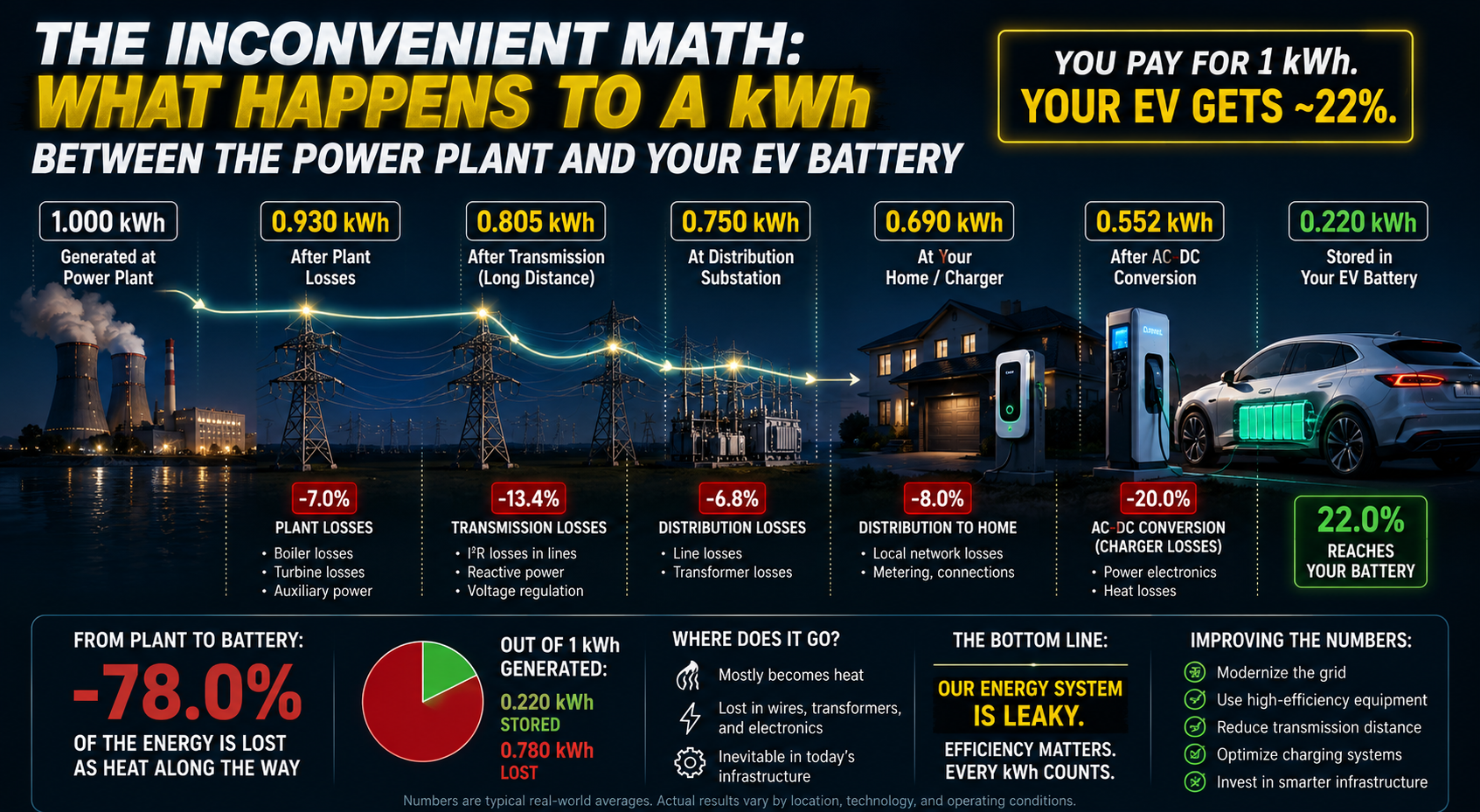
The Inconvenient Math: What Happens to a kWh Between the Power Plant and Your EV Battery
Public discourse treats an electric vehicle charged on the European grid as if the kilowatt-hour at the socket came directly from sunlight or wind. In reality, the chain from primary energy to wheels is full of losses — and most of them are invisible. Here is the honest math, and why it complicates the simple story.

An EV charging point. The kilowatt-hour that flows into the battery has already lost a significant fraction of the primary energy that produced it — often more than people realise. Photo: Michael Marais / Unsplash (free licence).
A claim that needs unpacking
“Electric vehicles are 80 to 90% efficient, while combustion engines are only 30%.” You have read this sentence a hundred times. It is repeated in every newspaper article on the energy transition, in every government communication, in every car manufacturer’s electrification brochure.
It is also, technically, true — but only if you measure efficiency at the wrong point in the chain.
The 90% figure refers to the electric motor itself. It is the fraction of electrical energy entering the motor that comes out as mechanical work at the wheels. It is a real and impressive number. But the electric motor is the last link in a long chain that starts at a power plant somewhere — and every link in that chain leaks energy.
The same logic applied to a combustion engine starts at the fuel pump, not at the well-head of the oil field that produced the petrol. If you measured a combustion vehicle’s efficiency from the fuel tank to the wheels, you would also get a figure around 30% — but you would have ignored the refinery, the distribution, and the transport of the crude oil. The comparison is honest only if both sides are measured from the same starting point.
So let us do that. Let us measure from the primary energy source — the fossil fuel, the wind turbine, the solar panel — to the wheels. The math is sobering on both sides.
The journey of one kWh from a gas-fired power plant to an EV battery
Suppose your local electricity comes from a modern combined-cycle gas turbine (CCGT) plant — the most efficient fossil generation technology, common across Europe. We start with 100 units of energy in the form of natural gas burned at the plant.
Sources: IEA, CEER (Council of European Energy Regulators), academic literature on electric vehicle efficiency. The exact figures vary slightly by country and equipment, but the order of magnitude is robust.
The largest single loss in this cascade — by a wide margin — is the first one. Burning gas to make electricity is itself only 55% efficient. A coal plant is worse, typically 35 to 40%. A nuclear plant, around 33% (heat rejection to the cooling river). The European grid mix in 2026 is still dominated by fossil and nuclear generation. Pure renewable hours exist, but they are not the average.
Grid losses — transmission and distribution combined — represent only about 5 to 8% in most European countries. They are real but modest. The big loss is upstream of the grid, in the power plant itself.
The honest comparison nobody publishes
Now let us run the same exercise for a Renault Mégane EREV running on e-fuel synthesised from renewable electricity — our previous pillar’s central scenario.
The chain is different: renewable electricity → electrolysis (~70% efficient) → e-fuel synthesis via Fischer-Tropsch (~70% efficient) → fuel distribution (~99%) → combustion in a 48%-efficient generator engine with waste heat recovery → battery storage → electric motor.
The well-to-wheel math: roughly 23% of the original renewable kWh ends up as motion at the wheels. Significantly worse than the EV’s 80% under renewable electricity, but the relevant comparison is not always made cleanly.
Read the second column carefully. The EREV running on e-fuel is less energy-efficient than the gas-grid EV. But it can be near-zero-carbon, while the gas-grid EV cannot. Energy efficiency and carbon intensity are two different things, and the public conversation conflates them constantly.
The EV is a brilliant carbon-cutting technology only when the electricity it consumes is itself low-carbon. In Norway, France, Sweden — where grids are dominated by hydro and nuclear — the EV math is overwhelming. In Germany, Poland, Italy, the Netherlands, where coal and gas still play a major role, the math is closer than the press releases suggest. And in some hours of the year, with coal at the margin, a modern hybrid running on petrol can actually emit less per kilometre than an EV charging at the same moment.
Two implications
This is not a defence of fossil fuels. The direction of travel is clear: European grids are decarbonising rapidly, EVs will get cleaner every year, and battery production is improving. The 2035 trajectory remains sound — for the use cases EVs serve best.
But two implications follow from the honest math, and they are the implications this site keeps returning to.
First, the comparison between EVs and e-fuel-powered combustion vehicles is not as one-sided as it is usually presented. When the relevant comparison is “EV on actual grid electricity” versus “EREV on renewable-sourced e-fuel”, the gap narrows considerably. In carbon terms, the e-fuel option can win. In behavioural terms — refuelling speed, long-range autonomy, no charging logistics — it wins easily.
Second, the renewable electricity question matters more than the vehicle question. Whether we decarbonise faster by building more wind and solar (so that EVs are actually charged on renewable kWh) or by building e-fuel production capacity (so that combustion vehicles run on synthetic petrol) is a real strategic debate. The answer is probably “both, in parallel, for different use cases”. It is certainly not “all-electric, all the time, regardless of where the electricity comes from”.
The kilowatt-hour at your socket is not innocent. It has a history, and a carbon footprint, that the marketing rarely shows. Once you do the honest math, the case for a multi-technology mobility system — battery electric for daily urban use, EREVs and e-fuels for longer trips and harder-to-electrify applications — becomes much harder to dismiss as nostalgia for the combustion era. It becomes, instead, basic energy arithmetic.
Sources: Council of European Energy Regulators (CEER) 3rd Report on Power Losses (2024); IEA World Energy Outlook (multiple editions); World Bank EG.ELC.LOSS.ZS dataset; academic literature on well-to-wheel analysis (Edwards et al., JEC consortium, various years); manufacturer specifications on AC/DC charging losses and battery round-trip efficiency.