
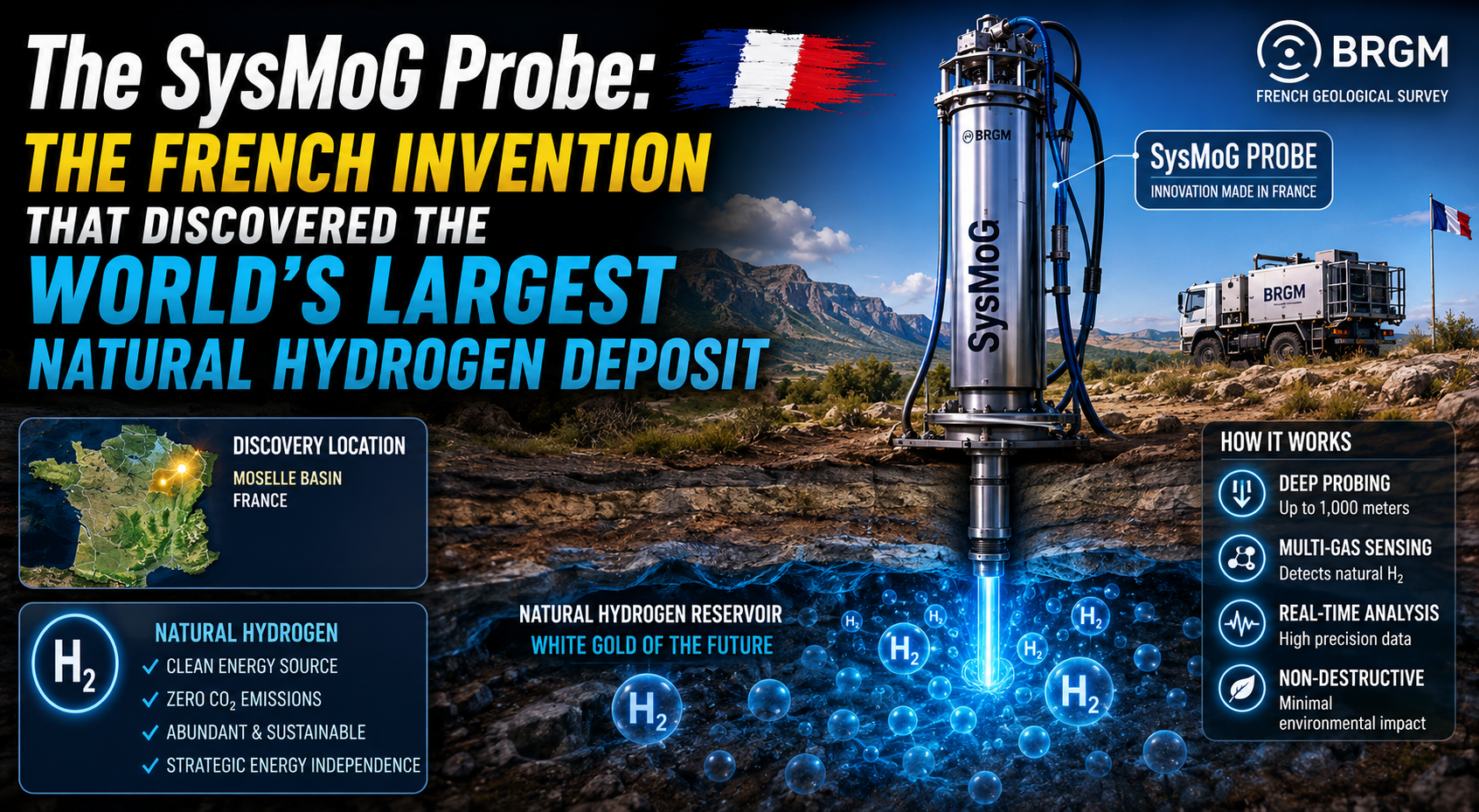
The SysMoG Probe: The French Invention That Discovered the World’s Largest Natural Hydrogen Deposit
A six-centimetre-wide probe, lowered into a former coal-mining borehole in eastern France, has fundamentally changed what we know about hydrogen on this planet. Here is how the SysMoG probe works, how the hydrogen will be extracted industrially, who built the technology — and where it goes next.

An industrial drilling rig. The Folschviller and Pontpierre boreholes operated by FDE use installations of comparable scale to explore the deep Carboniferous formations of the Lorraine basin. Photo: Zbynek Burival / Unsplash (free licence, no attribution required).
An accidental discovery
In late 2022, two researchers from the GeoRessources laboratory in Nancy — Jacques Pironon and Philippe De Donato, both senior research directors at the French CNRS — were not looking for hydrogen. They were looking for methane.
Their project, named REGALOR (REssource GAzière de LORraine, “Lorraine Gas Resource”), was a regional initiative funded by the European FEDER programme, the French State and the Grand Est Region, with industrial partner Française de l’Énergie (FDE). The objective was straightforward: assess the methane reserves trapped in the coal seams of the former Lorraine mining basin, with a view to local gas production.
To carry out their measurements, they needed an instrument that did not yet exist. The old methane boreholes of the Carboniferous basin, drilled in the 20th century, had narrow casings — typically 6 centimetres in inner diameter. No commercial probe on the market could descend into such tight spaces and analyse the gases dissolved in the deep groundwater.
So they built one.
Working with the Swiss-French engineering company Solexperts, the Nancy team designed a miniaturised monitoring probe slim enough to slide into a 6 cm well, long enough to reach depths of 1,200 to 1,500 metres, and equipped with a sampling system capable of pumping deep groundwater to the surface for real-time gas analysis. They called it SysMoG — short for “Système de Monitoring de Gaz”.
It was, when first deployed at Folschviller (a small commune 50 km east of Metz), a world first. Continuous, in-situ gas monitoring at that depth, in a borehole that narrow, had never been achieved before. The probe revealed exactly what was expected — high concentrations of methane in the coal-bearing layers, around 96% pure, with no toxic contaminants. But it also revealed something the researchers had not anticipated at all.
The deeper the probe went, the more hydrogen it found.
How the SysMoG probe actually works
The principle behind SysMoG is elegant, and surprisingly accessible once you break it down. It is not a single instrument — it is a sampling and analysis system, divided between the bottom of the well and the surface.

Real-time gas analysis at the wellhead. Infrared spectroscopy equipment of the type used to analyse the gas mixture extracted by the SysMoG probe. Each gas molecule absorbs light at unique wavelengths, allowing precise measurement of H₂, CH₄, CO₂, O₂ and N₂ concentrations in real time. Photo: Louis Reed / Unsplash (free licence).
Step 1 — Selective membrane sampling at depth
The probe contains a permeable polymer membrane. As it is lowered through groundwater at depth, dissolved gases — including hydrogen, methane, CO₂, nitrogen and oxygen — diffuse through the membrane into a controlled internal chamber. The key technical achievement is that the membrane is selective: it allows gases to cross, but blocks the water itself, along with most impurities. This eliminates the contamination problems that plague conventional gas sampling at depth.
Step 2 — Pumping the gas to the surface
The captured gas mixture is continuously transported up to the surface through a narrow tube integrated into the probe’s cable. The flow can be operated in two modes: static (waiting for equilibrium at one specific depth) or dynamic (sampling continuously as the probe is moved). This dual-mode capability is one of the elements protected by the European patent filed in April 2023.
Step 3 — Real-time infrared spectroscopy at the surface
At the wellhead, the gas mixture enters an infrared spectroscopy analyser. Each gas molecule has a unique infrared “fingerprint” — methane, hydrogen, CO₂ and nitrogen all absorb light at characteristic wavelengths. By measuring how much light each gas absorbs, the system can determine the concentration of every component in the mixture, in real time, with high precision.
The result is a continuous concentration profile of dissolved gases, as a function of depth. For the first time anywhere, geologists can build a high-resolution “gas map” of the deep subsurface, in situ, without destroying the sample.
- Diameter: under 6 cm — fits into legacy boreholes from the 20th century mining era
- Depth reach: 1,200 m demonstrated, 1,500 m theoretical maximum
- Analytes: H₂, CH₄, CO₂, O₂, N₂ measured simultaneously in real time
- Resolution: continuous depth profile, not single-point samples
- Patent: European patent application filed April 2023, jointly held by Université de Lorraine, CNRS and Solexperts
- Time to assess a well: less than 48 hours with the GH2asBusters variant
What it found in Lorraine
The Folschviller borehole, sampled progressively from late 2022 through 2023, gave numbers that the researchers initially struggled to believe.
At a depth of 600 to 800 metres, the gas dissolved in the deep aquifer was over 96% methane. Expected. At 1,100 metres, hydrogen concentration in the dissolved gas reached 14%. At 1,250 metres, the deepest measurement the probe could reach, hydrogen had climbed to around 20%. The concentration was rising approximately linearly with depth.
Extrapolated, the team’s geochemical model predicted that at 3,000 metres of depth, hydrogen could exceed 90% of the dissolved gas. If confirmed by deeper drilling, the Lorraine basin could hold up to 46 million tonnes of natural hydrogen — more than half the world’s current annual production of grey hydrogen, sitting under a 490 km² area in eastern France.

Above the Lorraine Carboniferous basin. The 490 km² basin where natural hydrogen has been detected extends across the Moselle and Meurthe-et-Moselle departments, between Metz and the German border. Below these rural landscapes, fractured coal beds act as natural migration channels for hydrogen rising from deeper formations. Photo: Federico Respini / Unsplash (free licence).
The hydrogen, the team believes, is generated by serpentinisation reactions in the deeper basement rocks — water reacting with iron-rich minerals to liberate hydrogen — combined with thermal cracking processes that have been active over geological timescales. The fractured Lorraine coal beds act as natural migration channels, bringing the deep hydrogen up to the levels where it can be detected, and ultimately, extracted.
Has SysMoG passed the real-world testing phase?
This is the question that determines whether the Lorraine discovery is a laboratory curiosity or an industrial reality. The short answer, as of May 2026, is yes — for the exploration and characterization phase. Here is the detailed status.
The bottom line: SysMoG has firmly passed the proof-of-concept and early commercial deployment stages. It is no longer a prototype. It is being used routinely on real exploration projects in Lorraine, and is now the reference technology for in-situ dissolved gas analysis in narrow boreholes globally. Its commercialisation through Solexperts gives it a path to industrial scale.
What remains to be solved is the deep-extraction question. Detecting hydrogen at 1,200 m is one thing. Confirming and quantifying it at 3,000 m, and ultimately producing it, requires technologies that are still being developed — including the next generation of SysMoG itself.
From detection to production: how do you actually extract the hydrogen?
Detecting hydrogen at depth is one challenge. Producing it at industrial scale, purifying it, and delivering it to customers is another — and it is the one that determines whether Lorraine becomes a real energy province or remains an interesting scientific curiosity.
The good news is that the engineering pathway, while still in development, is reasonably well understood. It draws on a century of experience in conventional gas production and on more recent advances in membrane separation. The bad news is that nobody, anywhere in the world, has yet operated a commercial-scale natural hydrogen production facility. Lorraine is poised to be one of the first.
Here is how it will work — in five stages.
Stage 1 — Drilling the production wells
The first step is unglamorous and capital-intensive. Detection wells like Pontpierre PTH-2 are scientific instruments — narrow, single-purpose, designed to confirm presence and measure concentration. Production wells are industrial infrastructure: wider in diameter (typically 18 to 30 cm), reinforced with multiple casings, completed with downhole pumps and pressure-control equipment, and connected to surface processing facilities.
For the Lorraine basin, where hydrogen is dissolved in deep aquifer water at 2,500 to 3,500 metres, production wells will resemble those used by the natural gas and geothermal industries. The technical partners already involved in PTH-2 — RED Drilling, Schlumberger (SLB), Baker Hughes and Weatherford — are the same companies that drill conventional oil and gas wells worldwide. The drilling expertise is mature. What is new is the well architecture, optimised for hydrogen rather than methane.
Cost order of magnitude: a single deep production well in this configuration is expected to cost between 5 and 15 million euros, depending on depth, geology and completion complexity. For commercial-scale production from the Trois-Évêchés permit area, FDE will need to drill several dozen wells, possibly more than a hundred, over the next decade.
Stage 2 — Bringing the dissolved gas to the surface
This is where the Lorraine extraction differs fundamentally from classical natural hydrogen production in places like Mali, where the gas is dry — already in gaseous form, trapped in conventional reservoirs. In Lorraine, hydrogen is dissolved in deep groundwater, similar to how CO₂ is dissolved in a closed bottle of sparkling water.
To produce it, the engineering principle is the same one any cook understands: reduce pressure and the dissolved gas escapes. The deep aquifer water is pumped upward through the production well. As it rises, hydrostatic pressure drops naturally — from approximately 300 bar at 3,000 metres to atmospheric pressure at the surface. The dissolved gases come out of solution and bubble out, in a process called degassing or flash separation.
At the wellhead, the gas-water mixture enters a series of separator vessels operating at decreasing pressures. The gas phase, now liberated, is collected and routed to the next stage. The remaining water — partially depleted in dissolved gases but still containing minerals and some residual hydrogen — has to be managed carefully.
This is where the engineering becomes subtle. To maintain economically viable extraction rates, the depleted water must either be reinjected back into the aquifer (closed-loop production, similar to geothermal energy) or treated and released. Reinjection is preferable for two reasons: it preserves aquifer pressure and prolongs reservoir productivity, and it avoids the environmental risks of discharging mineralised deep groundwater at the surface. FDE has indicated, in its permit documentation, that closed-loop reinjection is the targeted approach.
Stage 3 — Separating hydrogen from the other gases
The raw gas mixture coming out of the separators is not pure hydrogen. Even at the theoretical 90+ percent concentration that FDE projects at depth, the wellhead stream will contain methane (CH₄), carbon dioxide (CO₂), nitrogen (N₂), traces of helium, and water vapour. Industrial customers — fuel cells, steelmaking, e-fuel synthesis — require hydrogen at 99.9% purity or better. So the gas must be separated and purified.
Three industrial technologies are mature for this task:
Pressure Swing Adsorption (PSA) is the workhorse of the global hydrogen industry. It uses beds of solid adsorbent materials (typically zeolites or activated carbon) that selectively trap heavier molecules at high pressure and release them at low pressure. By cycling pressure through several beds in parallel, PSA delivers hydrogen at 99.99% purity in a continuous flow. Every gray and blue hydrogen plant in the world uses PSA. The technology is utterly mature, and supplied by companies like Air Liquide, Linde and Air Products.
Polymer membrane separation is more recent and increasingly attractive for natural hydrogen applications. Hydrogen is the smallest molecule in nature, and certain polymer membranes — particularly polyimide and polysulfone — allow hydrogen to pass through while blocking heavier gases. The technology requires less energy than PSA, has no moving parts, scales linearly (you simply add modules), and works well at the gas pressures naturally available at the wellhead. The Lorraine team has accumulated significant expertise on selective hydrogen membranes through its work on SysMoG, and this know-how transfers directly to industrial separation. Several US patents describe complete systems combining membrane separation with downstream PSA to achieve the best of both worlds — energy efficiency from the membrane stage, ultimate purity from the PSA polish.
Cryogenic distillation is the third option, used when very high purity is required and energy costs are not the primary constraint. It is more capital-intensive but proven at scale by industrial gas majors.
For Lorraine specifically, a hybrid membrane + PSA configuration is the most likely industrial design. This is what major gas separation specialists like Air Liquide are proposing for similar projects.
Stage 4 — The SYSPROG tool: bridging detection and production
One element that has received almost no media coverage is worth highlighting here. Alongside SysMoG (the detection probe), FDE and its research partners have developed a second tool called SYSPROG. While SysMoG is designed to measure gas concentrations and validate reserves, SYSPROG is positioned at the production end of the spectrum — it characterises the dynamic behaviour of the reservoir under flow conditions.
In simple terms: SysMoG tells you what is down there. SYSPROG tells you how fast you can extract it, how the reservoir responds when you pump, and whether the hydrogen flow is sustainable over time. Both tools will be deployed in tandem in the Trois-Évêchés permit area, and FDE has already announced that they will also be exported to test wells in Kansas, USA, starting in the second half of 2026. This positions the French innovation cluster as the de facto standard for the global natural hydrogen industry.
Stage 5 — Compression, storage and pipeline injection
Once purified, hydrogen has to be moved to its industrial consumers. This is where Lorraine’s geography becomes a unique advantage. Within a 100-kilometre radius of the Trois-Évêchés permit area sit:
- The MosaHYc hydrogen pipeline, operated by GRTgaz and Creos, connecting France, Germany and Luxembourg. Commissioning planned for late 2027. Capacity 50,000 tonnes of hydrogen per year by 2030. First major customer: the Dillinger Hütte steelworks in Saarland.
- The Carling industrial platform in Moselle, a historic petrochemical site in active reconversion, with TotalEnergies and other operators developing low-carbon chemistry.
- The Saarland steel cluster (Dillinger, Rogesa, ArcelorMittal Eisenhüttenstadt indirectly), all under pressure to decarbonise by 2030-2035.
- Multiple e-fuel and electrolyser projects announced along the MosaHYc corridor by Verso Energy, H2V, Gazel Energie, RWE and Iqony.
Natural hydrogen produced at the Trois-Évêchés permit can be compressed, injected directly into MosaHYc, and delivered to industrial consumers without ever being trucked or shipped. This is the missing economic link. Most hydrogen projects worldwide struggle with the cost of transporting and distributing the gas. Lorraine’s natural hydrogen comes out of the ground in the middle of a pre-built industrial consumption corridor.
For reference: the cost of compressing hydrogen from atmospheric to pipeline pressure (around 70 bar) and injecting it into a network represents typically 0.20 to 0.50 euros per kilogram. For natural hydrogen produced at potentially under one euro per kilogram, this transport cost remains modest and economically tolerable.
A realistic timeline
Combining all of these stages, FDE has indicated publicly that commercial production from the Trois-Évêchés permit could begin around 2030, ramping up progressively through the early 2030s. The intermediate steps are:
- 2026-2027: continued exploration drilling, characterisation of additional wells, geographic mapping of the reservoir.
- 2027-2028: pilot production well, in coordination with MosaHYc commissioning.
- 2028-2029: design and engineering of the first commercial-scale processing facility (membrane + PSA, reinjection system, pipeline tie-in).
- 2030 and beyond: progressive deployment of multiple production wells across the 2,254 km² permit area, with annual production scaling from kilotonnes to potentially hundreds of kilotonnes.
This timeline is consistent with FDE’s January 2031 first regulatory milestone, defined in the Trois-Évêchés permit decree, by which the company must demonstrate sustainable hydrogen flows.
All of the above assumes that flow rates from production wells will be commercially viable. A reservoir can contain enormous reserves but deliver them too slowly to be economic. This is the single biggest open question for Lorraine, and the reason FDE’s tracer tests and dynamic reservoir characterisation work through 2027-2028 is so critical. The geology says the hydrogen is there. The next phase has to prove it can be brought out fast enough to matter.
Why this Franco-Swiss innovation matters globally
The natural hydrogen industry, as a serious commercial endeavour, did not exist five years ago. Today, exploration permits are being issued across Europe, the United States, Australia, Mali, Albania and Brazil. Tens of millions of dollars are flowing into startups like Koloma, HyTerra, 45-8 Energy and FDE itself.
And every one of these projects faces the same fundamental challenge: how do you measure hydrogen accurately, in real time, at depth, without destroying the sample? Conventional gas chromatography requires laboratory analysis of physical samples. Mass spectrometry is expensive and slow. Acoustic sensing detects bulk gas but cannot distinguish hydrogen from other light gases. Until SysMoG, there was no standard answer.
By solving the measurement problem first, Pironon, De Donato, GeoRessources, the CNRS, the Université de Lorraine and Solexperts have not only discovered what may be the world’s largest natural hydrogen reservoir — they have also built the instrument that the entire global exploration industry now needs. The Lorraine basin may turn out to be the world’s largest deposit, or it may turn out to be one of several major fields. Either way, the technology used to find it is French, the patent is European, and the commercial operator is Solexperts.
For a region long associated with the decline of heavy industry — Moselle’s coal mines closed definitively in 2004 — it is a remarkable return to the front line of European energy history. The same Carboniferous formations that powered the industrial revolution may yet power the next one.

A new chapter for Lorraine. The same Carboniferous formations that powered the industrial revolution may yet power the next one. From coal mining to natural hydrogen, the region is quietly becoming one of Europe’s most strategic energy territories. Photo: Bailey Zindel / Unsplash (free licence).
Sources: CNRS Le Journal (2023), Factuel Université de Lorraine (2024), The Conversation – Pironon & De Donato (2023 & 2025), Solexperts press releases (2024-2026), French Ministère de l’Écologie public consultation file “Trois-Évêchés” (Pontpierre 2025), FDE company communications.