
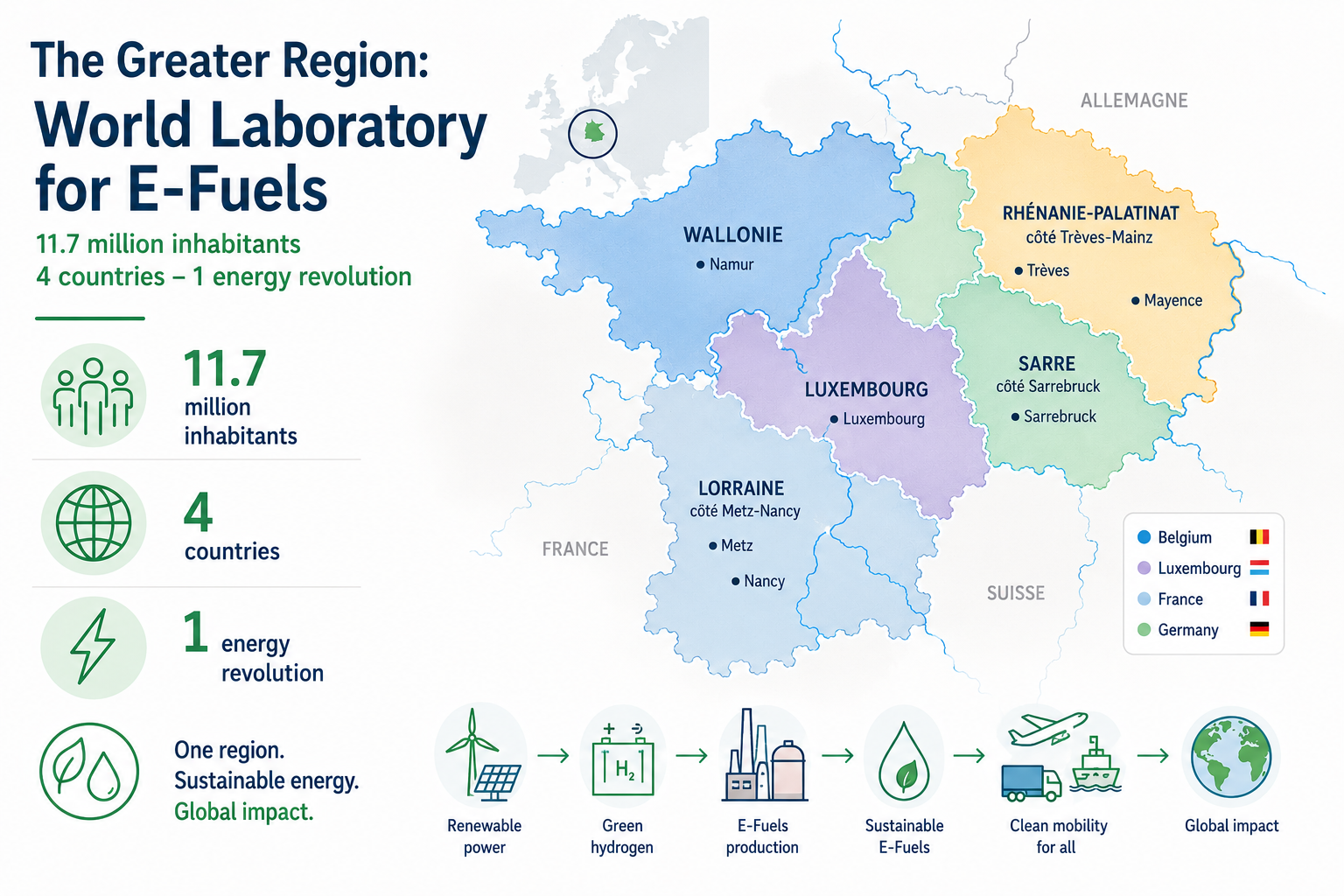
11 million inhabitants. 4 countries. 2 cross-border hydrogen pipelines. 1 CO₂ network under construction. A potential 46-million-tonne white hydrogen deposit 100 km away. And a steel industry reinventing itself from Liège. The Greater Region may be the best-positioned territory in the world to produce competitive synthetic fuels by 2035.
1. A region with energy in its DNA
The Greater Region is not a recent bureaucratic construct. It is a territory whose shared industrial history stretches back two centuries. Wallonia’s coal fed the Lorraine blast furnaces. Lorraine’s iron ore transited through Saarland. Belgian steel from Liège was exported to Luxembourg. These cross-border economic flows forged infrastructure, networks, competencies — and a culture of industrial cooperation that few European regions possess.
Today, these same territories face the same transition: decarbonising a historically heavy industry while maintaining employment. And for the first time in a long while, the conditions are in place for this transition to be driven — rather than endured — and potentially exported as a model. The reason? Three strategic assets that happen to be located precisely here, within pipeline reach.
2. mosaHYc and HY4Link: the hydrogen veins of the Greater Region
The backbone of any e-fuels system is infrastructure. Without a pipeline to transport hydrogen from production zones (the North Sea coast) to industrial consumption zones, large-scale decarbonisation is not possible. In the Greater Region, two major projects are drawing precisely this backbone.
mosaHYc: the first operational trunk line — 2026
mosaHYc (moselle-saar-Hydrogen-conversion) is the most advanced project. Led by Creos (Germany grid) and GRTgaz (France), in cooperation with Encevo (Luxembourg), it aims to create a 100 km pure hydrogen pipeline network in the Greater Region, by repurposing 70 km of existing, currently unused gas pipelines — a cost-effective and environmentally sound approach — and building 30 km of new pipes.
The mosaHYc network is targeted to become operational in 2026, with a maximum capacity of 120,000 m³/h and an ambition to transport more than 50,000 tonnes of hydrogen annually by 2030. That is equivalent to approximately 250 MW of continuous green hydrogen — a significant industrial volume for a region that is just getting started.
HY4Link: the grand cross-border corridor — EU PCI status secured
If mosaHYc is the first trunk line, HY4Link is the motorway. Led by Creos Luxembourg, Fluxys hydrogen (Belgium) and GRTgaz/NaTran (France), the project obtained Project of Common Interest (PCI) status from the European Commission in November 2025 — the EU’s highest designation for cross-border energy infrastructure. This is not a proposal on paper. It is an officially recognised European project.
“HY4Link will contribute to the development of a regional hydrogen economy and offer local industrial customers access to competitive renewable and low-carbon hydrogen to accelerate their decarbonisation.”
— Sandrine Meunier, CEO of GRTgaz · Source: NaTran official MOU
HY4Link is designed to connect industries in France, Germany and Luxembourg to hydrogen import hubs in Antwerp, Zeebrugge, Rotterdam and Dunkirk. Crucially, the project explicitly includes a Belgium–Luxembourg connection via the Bras border crossing, linking to the Belgian hydrogen backbone towards Liège. This is not a minor technical detail — it is the formal recognition that the Liège basin is a key node in the future hydrogen economy of the Greater Region.
3. The CO₂ pipeline: the forgotten piece of the puzzle
PtL (Power-to-Liquid) e-fuels need two raw materials: green H₂ and CO₂. While hydrogen grabs the headlines, CO₂ is often the overlooked variable. Yet this is where the Greater Region holds an asset that is rarely mentioned in the same breath as the hydrogen infrastructure: massive industrial CO₂ emissions that need to be captured — and an infrastructure being built to transport them.
The Fluxys c-grid Antwerp — a CO₂ transport network from Antwerp towards the North Sea for geological storage — was designated Low-Carbon Network Operator (LCNO) by Belgian authorities in March 2026, for a 20-year term. Phase 1 is expected to be completed by end-2026. Antwerp is approximately 100 km from Liège. And industrial CO₂ emitters in the Greater Region are numerous: cement plants, steelworks, refineries, chemical plants.
The logical connection presents itself: capture the CO₂ emitted by Lorraine, Walloon and Saarland industries, transport it via pipeline, and use it as raw material for local PtL plants — rather than sending it to the North Sea for geological storage. Industrial CO₂ costs €20–100/tonne versus €400–1,000/tonne for atmospheric capture (DAC). The economics are compelling.
4. Lorraine white hydrogen: the hidden asset 100 km away
Beneath the hills of Moselle, a few decades of mining geology away from the Liège basin, lies what may be the best-kept secret in European energy: white hydrogen — native, natural, produced by geochemical reactions in the subsurface over millions of years, with no human intervention and no energy input required.
In 2023, teams from the University of Lorraine (CNRS, GeoRessources) detected exceptional concentrations of H₂ dissolved in groundwater in the Lorraine mining basin: 1% at 600 m depth, rising to 17% at 1,100 m. A conservative initial estimate put the potential at 46 million tonnes of white H₂ in the Folschviller/Pontpierre area.
In January 2026, the REGALOR II borehole at Pontpierre confirmed strong H₂ concentrations from −2,000 m. Simultaneously, the exclusive exploration permit “Trois Évêchés” — covering 2,254 km² across Moselle and Meurthe-et-Moselle — was published in the French Official Journal on 28 January 2026. It is the first white hydrogen exploration permit granted among six applications currently under review in France.
Liège is 80 km from Pontpierre. The HY4Link pipeline will explicitly connect Lorraine to Belgium. If Lorraine’s white H₂ is confirmed, it could be injected into this pipeline and transported directly to Belgian PtL plants — including in the Liège basin. This is a 2030–2035 scenario, not a 2026 reality — but it is a scenario now planned in official documents.
5. Liège steelmaking: from problem to solution
Here is something worth reading carefully — and perhaps a prospective thought we put forward for debate. The steelmaking industry of the Liège basin has for decades been perceived as a problem: declining employment, closed blast furnaces, industrial brownfields. The trajectory has not been kind. But one thing can transform a “problem” into a “solution” in the energy transition: demand for captured CO₂.
The reasoning: one tonne of primary steel produces approximately 1.8–2 tonnes of CO₂. Steel is responsible for around 8% of global CO₂ emissions. To decarbonise, two routes exist: green hydrogen (replacing coke with H₂ in blast furnaces via DRI — direct reduction of iron) and carbon capture (CCS/CCU on residual emissions).
John Cockerill: Seraing at the heart of the hydrogen revolution
The John Cockerill Group — whose roots are in Seraing (Liège), founder of Belgian steelmaking in the 19th century — is today one of the world leaders in green hydrogen electrolyser manufacturing. In 2025, the group exceeded €2 billion in recorded orders and continues to assemble its hydrogen electrolysers at the Seraing site.
In June 2025, John Cockerill Hydrogen finalised a €116 million capital increase to pursue its strategic development plan, backed by SFPIM, Wallonie Entreprendre, SLB, Rely — and with Fluxys entering as a strategic partner by acquiring a stake. The entry of Fluxys — the same Fluxys building the Antwerp CO₂ network and participating in the HY4Link pipeline — into the capital of John Cockerill Hydrogen is not coincidental. The pieces of the puzzle are connecting.
Four giant electrolysers manufactured at Seraing were transported by exceptional convoy to Zeebrugge in 2026, destined for Belgium’s first large-scale green hydrogen production plant, expected to come online during 2026. Meanwhile, a new green hydrogen production unit at Engis (Province of Liège) is in project by Virya Energy, with a €60 million investment, using three pressurised alkaline electrolysers of 5 MW each — designed by John Cockerill.
Steelmaking as a CO₂ supplier for e-fuels
Here is the prospective reflection we wish to put forward — and which, to our knowledge, has not yet been publicly formulated in quite this way. Steel plants in the Liège basin that are decarbonising need green H₂. They will inevitably capture residual CO₂ in the process. This captured CO₂, rather than being sent to geological storage, could become the raw material of local PtL plants producing e-fuels.
The value chain would then be:
6. The power of 4-country cooperation
What makes the Greater Region particularly compelling is that its four constituent entities have complementary — not competing — assets.
Wallonia brings historical industrial expertise, metallurgical skills, John Cockerill (electrolysers), cement plants (Carmeuse, Heidelberg Materials at Lixhe — future CO₂ sources), and an active regional support network (Wallonie Entreprendre, GRE Liège).
Luxembourg brings financing (the Luxembourg financial centre), Creos (H₂ network operator), Encevo, and an exceptionally well-established cross-border cooperation diplomacy — Luxembourg is a natural pivot between its three neighbours.
Lorraine brings resources: potentially white hydrogen (Pontpierre), the steelmaking industry of Florange, connections to the H2Med corridor (Cerville-Nancy), and GRTgaz/NaTran as transport operator.
Saarland brings industrial demand (HydroHub Fenne, H₂SYNgas, automotive industry in transition), connections to the Rhineland-Palatinate and North Rhine-Westphalia, and a long tradition of Franco-German industrial cooperation.
“By linking industrial demand clusters with green hydrogen producers along the North Sea coast, HY4Link will play a pivotal role in the decarbonisation efforts in Luxembourg and the Greater Region.”
— Laurence Zenner, CEO of Creos Luxembourg · Source: NaTran official MOU
7. E-fuels as the logical endpoint
Put all these elements together — cross-border H₂ pipelines, a CO₂ network under construction, white hydrogen potential, heavy industry decarbonising, electrolyser expertise — and the question that arises is: where will the PtL plant be located that transforms all this into e-fuels?
The Greater Region does not yet have a PtL plant officially announced on its soil. ArcelorMittal is working on CCU solutions to synthesise e-fuels from CO₂ captured in steelmaking gases — but on the Dunkirk site, not yet in the Greater Region proper. Connections to LanzaTech FLITE (Ghent, €500M, operational 2028) exist via the Fluxys network.
But the economic logic is compelling. A PtL plant seeks three things: cheap H₂, cheap CO₂, and cheap renewable energy. In the Greater Region by 2030, the first two conditions will be in place. The third depends on renewable energy policies in Wallonia and Grand-Est — a work in progress, but one with clear direction.
Conclusion: a region playing in the big leagues
The Greater Region is often invisible in the grand European energy narratives. People talk about Rotterdam, Hamburg, Marseille, Barcelona. Rarely about Liège, Luxembourg, Metz or Saarbrücken in the same breath.
Yet the facts are there. Two cross-border H₂ pipelines with European PCI status. A CO₂ network under construction from Antwerp. A potentially enormous white H₂ deposit in Lorraine. John Cockerill manufacturing tomorrow’s electrolysers from Seraing. Fluxys entering the capital of John Cockerill Hydrogen. And 11 million inhabitants whose industrial employment depends on a successful transition.
This is not naïve speculation. These are concrete industrial projects, with obtained financing, granted permits, designated operators. The Greater Region is positioning itself as one of Europe’s first integrated e-fuels territories. It is time the world took notice.
Author’s note: This article combines verified, sourced facts with prospective reflections clearly identified as such. Figures on HY4Link (PCI Nov. 2025), mosaHYc (operational 2026), Fluxys c-grid (LCNO March 2026), John Cockerill Hydrogen (€116M June 2025, Seraing electrolysers), the Lorraine deposit (CNRS 2023, permit JO 28/01/2026) are official and verifiable. The “Liège steelmaking → CO₂ → e-fuels” scenario is the author’s own reflection, not an announced project. · Stéphane Séquaris · BESS Energie SRL · info@bess.be · May 2026
📋 Full sources list
- HY4Link — NaTran/GRTgaz/Creos/Fluxys official MOU · PCI Nov. 2025
- mosaHYc — GRTgaz FID April 2024 · WTS Energy Jan. 2026 · grande-region-hydrogen.eu official
- HY4Link — Le Quotidien Luxembourg Dec. 2025 · H2Today Aug. 2024 · Energynews.pro
- John Cockerill Hydrogen — €116M capital increase press release · June 2025 · johncockerill.com official
- John Cockerill — La DH/Les Sports+ Apr. 2026 · RTBF · Qu4tre.be March 2026
- King Philippe visit — John Cockerill official press release · Feb. 21, 2025
- Fluxys c-grid Antwerp — LCNO designation March 2026 · Fluxys official
- Lorraine white hydrogen — CNRS/GeoRessources official 2023 (Pironon & De Donato)
- REGALOR II Pontpierre — France 24/AFP Jan. 27, 2026
- Trois Évêchés permit — French Official Journal Jan. 28, 2026 (2,254 km²)
- IFPEN — Natural hydrogen report · DGEC June 2025
- ArcelorMittal green steel — France 2030 dossier · Feb. 2022 · Cairn.info Nov. 2022
- Virya Energy Engis — 60M€ · John Cockerill 5 MW electrolysers · La DH Apr. 2026
- LanzaTech FLITE Ghent — €500M · May 2026 · LanzaTech official
- USGS white hydrogen — Ellis & Gelman · Science Advances · Dec. 2024