

E-Fuels Are No Longer a Bet —
They Are a Reality:
7 Concrete Proofs from Belgium and Europe
LanzaTech Ghent · TotalEnergies Antwerp · CO₂ pipeline · H₂ Grand Region · Renault range extender · Energy security · Tax reform — the debate is over
For years, e-fuels were dismissed as expensive, marginal and uncertain. Critics — often from the electric vehicle lobby — argued that Power-to-Liquid synthetic fuels would never scale, never become affordable, and never find a real market. In 2026, that debate is over. Not because of wishful thinking or political promises — but because concrete industrial decisions, confirmed investments and infrastructure commitments are accumulating at a pace that leaves no room for doubt. Belgium alone, in the space of a few weeks, has seen three major e-fuels and SAF announcements. Europe’s hydrogen and CO₂ infrastructure is taking shape. Renault has officially committed to range-extender hybrids that run on synthetic fuels. And the geopolitical context — with Middle Eastern supply routes under pressure — is turning energy sovereignty from a climate argument into a defence and security imperative. Here are 7 concrete, verifiable proofs that e-fuels are no longer a bet.
The Old Debate — and Why It Is Now Settled
The standard criticism of e-fuels went like this: “They are 5 to 8 times more expensive than fossil fuels. They waste energy — you need 5 kWh of electricity to produce the equivalent of 1 kWh of e-fuel. The electric vehicle is simply more efficient. E-fuels are a lobby trick by the oil industry to delay the energy transition.”
This criticism had — and still has — some technical validity. The energy efficiency argument is real: Power-to-Liquid does use more primary electricity than direct battery charging. But this argument misses three fundamental points that have become increasingly obvious in 2025–2026:
1. Not all sectors can be electrified. Aviation, deep-sea maritime, heavy industry, long-distance trucking, and 200M+ legacy ICE vehicles cannot simply switch to battery power. E-fuels are not competing with EVs in urban commuting — they are filling the gaps that EVs cannot fill.
2. The efficiency argument ignores the system. In a world with abundant renewable electricity (which Europe is building rapidly), the “waste” of PtL synthesis is not a problem — it is a feature. Excess renewable electricity that cannot be absorbed by the grid can be stored as e-fuels rather than curtailed. The real cost is not the conversion efficiency — it is the cost of green hydrogen.
3. The economic calculus for low-mileage users is different. For someone who drives 5,000–8,000 km/year, the higher cost per litre of e-fuel is more than offset by the lower purchase price of a conventional vehicle. The total cost of ownership calculation favours e-fuels for this profile — which represents a significant portion of European drivers.
Proof #1 — LanzaTech Selects Belgium: €500M, 79,000t SAF
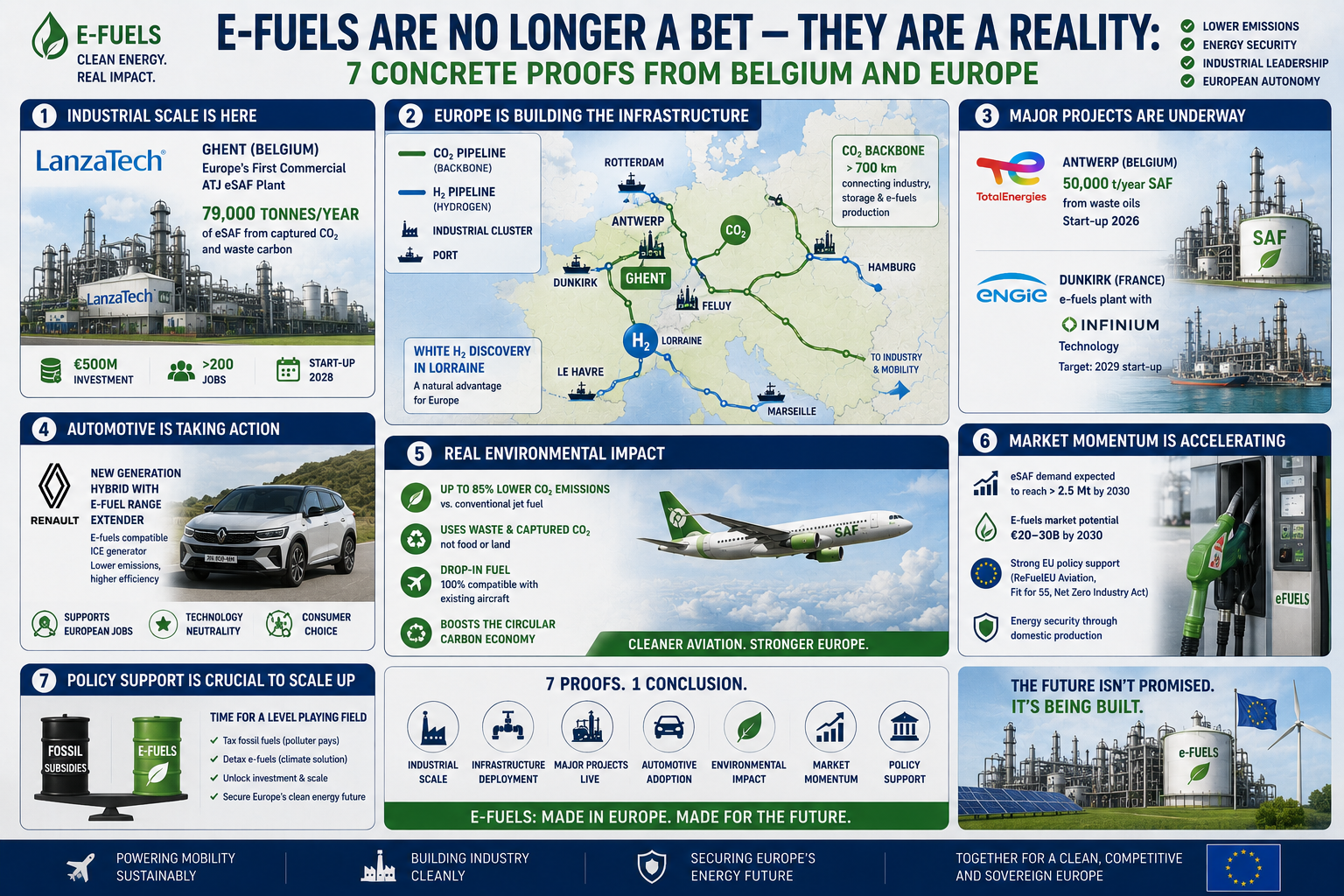
LanzaTech Global (NASDAQ: LNZA) has selected North Sea Port, Ghent, Belgium as the permanent site for the FLITE project — Europe’s first commercial-scale Alcohol-to-Jet Sustainable Aviation Fuel facility. The €500 million plant will produce 79,000 tonnes of SAF and 9,000 tonnes of renewable diesel annually, supported by EU Horizon 2020 funding. FEED is substantially complete. Environmental Impact Assessment scoping notification imminent. The site sits adjacent to ArcelorMittal’s Steelanol ethanol plant — providing co-located feedstock. This is not a feasibility study. Not a pilot. Not a promise. It is a confirmed site, secured financing, completed engineering and imminent regulatory filing. The project creates approximately 50 permanent jobs and 300 FTE during construction.
Source: LanzaTech official press release May 11, 2026 · North Sea Port official · Globe Newswire — verifiedProof #2 — TotalEnergies Antwerp: 50,000t SAF Already Commissioning
TotalEnergies announced on April 22, 2025 the addition of SAF production capacity at its Antwerp refinery via coprocessing — simultaneously processing biomass with conventional hydrocarbons. Initial capacity: 50,000 tonnes per year of SAF. Production started in 2025. Antwerp joins TotalEnergies’ four French SAF sites (Grandpuits 230,000 t/yr from 2026, La Mède, Normandie, Oudalle) as Belgium’s first TotalEnergies SAF production point. Combined Belgium capacity from these two projects alone: 129,000 t/yr — approximately 6.8% of the EU’s entire 2025 SAF mandate target, in one country.
Source: TotalEnergies official April 22, 2025 · Biomass Magazine · BioEnergy Times — verified
Proof #3 — The CO₂ Pipeline: Industrial Waste Becomes E-Fuel Feedstock
The Port of Antwerp-Bruges, as part of the Antwerp@C consortium, is building a CO₂ pipeline cluster in Antwerp with a connection to Germany by 2030 and a subsea CO₂ highway to Norway for permanent geological storage. Fluxys holds a stake in the C Grid. This infrastructure has a direct e-fuels implication that is often overlooked: Power-to-Liquid e-fuels require CO₂ as a feedstock alongside green hydrogen. Belgium’s cement industry and steel production emit tens of millions of tonnes of CO₂ annually. A CO₂ pipeline connecting these emitters to future PtL plants provides a far cheaper alternative to Direct Air Capture (currently €400–1,000/tonne) — potentially reducing e-fuel production costs by €0.50–1.50/litre. The infrastructure is being built for CO₂ storage — but it is simultaneously the infrastructure that makes large-scale Belgian PtL e-fuel production economically viable.
Source: Port of Antwerp-Bruges official · Hydrogen Technology World Expo 2025 presentation · Fluxys official — verifiedProof #4 — The Grand Region H₂ Network: Lorraine to the Ports
The mosaHYc hydrogen pipeline (€110M, FID April 2024) will convert 90 km of existing gas pipelines to transport hydrogen between the Lorraine region of France and Saarland, Germany — commissioning planned for 2027. GRTgaz manages the French section (50 km); CREOS Deutschland the German section (40 km). Simultaneously, Fluxys is building hydrogen pipeline clusters at Antwerp (construction started 2025), connecting to the Netherlands at Zandvliet, with plans for Belgium-Germany interconnection by 2028. Belgium’s national hydrogen strategy targets 100–160 km of H₂ pipelines by 2026 and cross-border interconnections by 2028.
The strategic significance: Lorraine’s white hydrogen deposit (46 Mt estimated, REGALOR II drilling underway at 4,000m, January 2026) sits at the heart of this emerging H₂ corridor. If commercially exploitable, Lorraine white hydrogen flowing through mosaHYc and then via Belgian pipeline networks to Antwerp PtL plants would create the cheapest e-fuel production corridor in Europe. The infrastructure is being built now — regardless of the white hydrogen outcome.
Source: ENGIE official · GRTgaz FID April 2024 · Fluxys official · Belgium Hydrogen Strategy · Green Hydrogen Organisation Belgium — verified

Proof #5 — Renault’s “Valise” Engine: The Range Extender That Changes the Road Transport Calculus
At its March 2026 Strategy Day, Renault officially announced the futuREady strategy — including a new 800V RGEV medium 2.0 electric platform targeting up to 1,400 km of range with a range extender. Renault CEO Fabrice Cambolive confirmed: “We also think that if adoption is not as rapid as expected, perhaps you can complete this with some extensions like range extender or plug-in hybrid, and that’s what we are working on.”
The technology is already production-ready. Horse Powertrain — the joint venture between Renault and Geely — presented the Horse C15 at IAA Mobility 2025: an ultra-compact range extender system (50 × 55 × 27.5 cm) that integrates engine, generator, cooling and inverter into a single unit. It can be installed horizontally or vertically — in the front compartment or the rear — transforming an existing BEV platform into a range-extended EV with minimal modification. Crucially, the Horse system is explicitly designed to run on “gasoline, ethanol flex fuels, pure methanol or modern synthetic fuels” — including e-fuels. Horse Powertrain is already supplying its HR10 engine to Brazilian manufacturer Lecar for 12,000 units/year (2026 launch).
Sources: Renault Strategy Day March 2026 · Auto Express March 10, 2026 · Motor1 March 16, 2026 · electrive.com September 5, 2025 (Horse C15 IAA) · InsideEVs April 17, 2025 · Mobiwisy September 24, 2025 — verifiedProof #6 — The Economic Reality: E-Fuels Are Not Marginal for Low-Mileage Users
The standard comparison between EVs and e-fuel vehicles focuses on the energy cost per kilometre — and in this comparison, EVs win. But the total cost of ownership (TCO) analysis is more nuanced:
| Cost element | EV (citadine type Renault 5) | ICE + e-fuels (2030 scenario) |
|---|---|---|
| Purchase price | ~€30,000 | ~€22,000 (−€8,000) |
| Energy cost / 150,000 km | €5,625 (15 kWh × €0.25 × 1,500) | €20,625 (5.5L × €2.50 × 1,500) (+€15,000) |
| Maintenance 10 years | €1,500 | €3,000 (+€1,500) |
| Battery end-of-life cost | €500–1,800 recycling | €0 (−€500/1,800) |
| TOTAL 150,000 km | ~€37,125 | ~€45,625 |
| Cost per km | €0.25/km | €0.30/km |
| Breakeven mileage | E-fuel vehicle cheaper up to ~60,000–70,000 km (for 5,000 km/yr driver: >12 years) | |
Proof #7 — Energy Security: The Iran Context Makes E-Fuels a Strategic Necessity
Europe imports approximately 85% of its transport fuel feedstocks from regions that are either geopolitically volatile or actively adversarial. The ongoing tensions around Iran — a key actor in the Strait of Hormuz chokepoint through which approximately 20% of global oil trade flows — are a structural reminder of this vulnerability. This is not a transient crisis: European energy import dependency has been structurally dangerous since before the Russia-Ukraine war demonstrated exactly what happens when a major European energy supplier weaponises supply. The lesson should have been learned.
E-fuels produced from domestic European renewable electricity, CO₂ captured from local industrial sources and green or natural hydrogen are — by definition — immune to Middle Eastern geopolitics. A litre of e-kerosene produced at LanzaTech’s future Ghent plant or INERATEC’s Frankfurt ERA ONE facility cannot be subject to an Iranian oil embargo, a Hormuz closure or a Gulf state production cut. This is not a climate argument. It is a defence and security argument that should resonate across the political spectrum — from Green parties to traditional conservatives and defence hawks alike.
Note: The geopolitical analysis reflects the structural energy security argument based on publicly available import dependency statistics (European Commission official data). Not a prediction of specific geopolitical events. Not investment advice.
The One Missing Piece: Fiscal Policy
Seven concrete proofs that e-fuels are real. But one obstacle remains artificial: e-fuels pay the same excise taxes as the fossil fuels they replace. In Belgium, petrol excise duty is approximately €0.60/litre. An e-fuel producer selling at €2.50–3/litre (realistic 2030 price) faces the same excise burden as a fossil fuel producer selling at €0.70/litre. This makes the effective consumer price premium of e-fuels larger than it needs to be.
Option 1: Excise duty differentiation — Zero or reduced excise on certified e-fuels under the EU Energy Taxation Directive (revised 2024, which allows member state flexibility). A €0.40/litre excise reduction on e-fuels would bring a €2.50/litre e-fuel to €2.10/litre effective consumer price — significantly closing the gap with fossil fuel at €1.30/litre.
Option 2: Carbon surcharge on fossil fuels — Extending and accelerating EU ETS carbon pricing on transport fuels. At €150/tonne CO₂ (feasible by 2030), petrol would cost approximately €0.35/litre more — further closing the gap with e-fuels without a single euro of direct subsidy.
Option 3: E-fuel certification fast-track — The EU 2035 ICE e-fuel exemption (March 2023 compromise) is still awaiting a certification methodology from the European Commission. Every month of delay is a month of investment uncertainty for e-fuel producers. A clear certification framework by end of 2026 would unlock billions in private investment.
Conclusion: The Debate Is Over — the Implementation Begins
In 2023, the question was “Will e-fuels ever happen?”
In 2026, the question is “How fast can we scale what is already happening?”
Seven concrete, verifiable proofs — €500M confirmed in Ghent, 50,000t SAF commissioning in Antwerp, a CO₂ pipeline being built, a hydrogen corridor from Lorraine to the North Sea ports, Renault officially adopting range-extender engines compatible with synthetic fuels, an economic case for low-mileage users, and a geopolitical imperative that transcends the climate debate — leave no room for the dismissal of e-fuels as a “niche lobby trick.”
E-fuels are not replacing electric vehicles. This is not a binary choice. The energy transition will be powered by multiple technologies in parallel — battery EVs for urban mobility, e-fuels for aviation and maritime, range-extender hybrids for rural and long-distance use, e-fuels for the existing fleet of 200M+ ICE vehicles in Europe. The question is not “which technology wins” — it is “how do we deploy all of them at the speed the climate and the geopolitical situation require.”
The infrastructure is being built. The investments are confirmed. The engines are production-ready. The only thing missing is the fiscal policy to bridge the remaining cost gap — and the political will to deliver it before 2030.
🔗 Also explore: syntheticfuels.ai — technology & market · e-saf.ai — eSAF aviation · syntheticfuelsmarket.ai — market data · synfuels.ai — weekly news
LanzaTech FLITE Ghent: LanzaTech Global official press release May 11, 2026 · North Sea Port official · Globe Newswire · Indian Chemical News May 15, 2026 · Aviation Week May 11, 2026 — verified.
TotalEnergies Antwerp SAF: TotalEnergies official April 22, 2025 · Biomass Magazine · BioEnergy Times April 24, 2025 — verified.
CO₂ pipeline Belgium: Port of Antwerp-Bruges official (Hydrogen Technology World Expo 2025) · Fluxys official — verified.
Grand Region H₂ / mosaHYc: ENGIE official · GRTgaz FID announcement April 2024 · Fluxys official · Belgium National Hydrogen Strategy (October 2022) — verified.
Renault range extender: Renault Strategy Day (futuREady) March 2026 · Auto Express March 10, 2026 · Motor1 March 16, 2026 · electrive.com September 5, 2025 (Horse C15 IAA Mobility) · InsideEVs April 17, 2025 · Mobiwisy September 24, 2025 · Renault CEO Fabrice Cambolive official statements — verified.
TCO analysis: Based on methodology inspired by public analysis (bess.be, September 2023) cross-referenced with EASA reference prices · eFuel Alliance cost data — indicative, not investment advice.
Energy security / Iran: European Commission import dependency statistics (official) · structural geopolitical analysis only — not a prediction of specific events.
EU ETD / fiscal framework: EU Energy Taxation Directive revision 2024 · European Parliament March 2023 ICE compromise — official.
Disclaimer: Documentary portal. All data from named sources as cited. Not investment advice. Geopolitical references are structural analysis only. BESS Energie SRL · BCE 0698.949.732 · Avenue Reine Astrid 224/00 · 4802 Heusy (Verviers, Belgium) · info@bess.be · e-fuels.ai