
EREVs, e-Fuels and Natural Hydrogen: The Real European Energy Strategy Nobody Is Explaining
In just six months, between December 2025 and March 2026, four major announcements have quietly reshaped the European energy and mobility landscape. Each one made headlines individually. None has been connected to the others. Together, they tell a story that contradicts almost everything we have been told about 2035 — and they reveal where the real industrial bets are being placed.
Europe’s Hidden 2035 Strategy:
EREVs, e-Fuels & Natural Hydrogen
Four signals from Brussels, Renault, FDE and Horse Powertrain reveal the real European energy strategy. Nobody has connected the dots — until now.
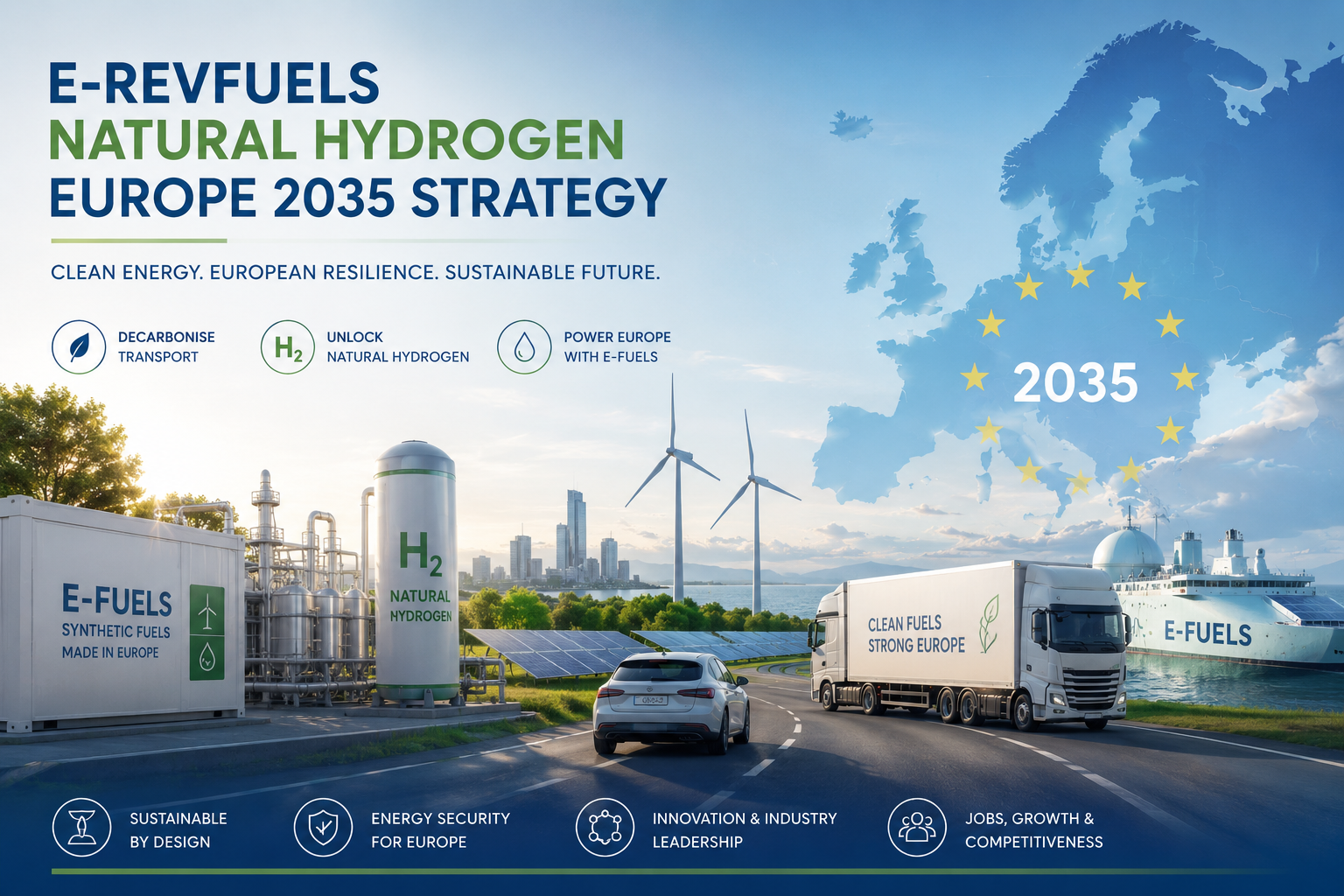
Europe is quietly building a multi-technology energy system: electric for daily trips, EREVs for long ones, e-fuels to feed the small thermal engines, hydrogen — green and white — to make the e-fuels. The Lorraine–Saar–Luxembourg corridor is becoming the continent’s first integrated laboratory.
I. The narrative we were sold
For three years, the European story on transportation decarbonization has been told as a single line. A clean, simple, almost monotone line.
In 2035, the sale of new combustion-engine vehicles would be banned across the European Union. Everyone would switch to electric. Carmakers would either adapt or die. Oil majors would either pivot or disappear. And public charging infrastructure would somehow scale fast enough to absorb the transition. The European Green Deal had spoken, the Council had voted, the manufacturers had — reluctantly — aligned. The debate was closed.
Except it wasn’t.
In the past six months, four announcements have fundamentally altered that trajectory. They came from very different places — the European Commission, a Franco-Chinese-Saudi engine joint venture, a small French energy company drilling in Moselle, and Renault’s strategic planning department. They concern completely different industries — regulation, automotive engineering, geological exploration, and electric vehicle architecture. On the surface, they have nothing to do with each other.
Yet read together, they describe a coherent industrial strategy. A strategy that is being executed quietly, without fanfare, by some of the largest industrial actors in Europe. A strategy that nobody in mainstream media has bothered to assemble into a single picture.
This article does precisely that. We are going to walk through each of the four signals, in chronological order, and then we are going to ask the question that follows: what energy system is Europe actually building? Because the answer, once you see it, is impossible to unsee — and it has enormous consequences for investors, automakers, oil companies, regulators, and ordinary drivers.
II. Signal one — December 16, 2025: Brussels softens the 2035 ban
The first crack appeared in mid-December 2025, in a press conference that received less attention than it deserved. The European Commission, under sustained pressure from Berlin, Rome and a coalition of automotive industry lobbyists, announced a revision of its 2035 regulation on CO₂ emissions from new vehicles.
The headline figure changed quietly but decisively. The original target — a 100% reduction in CO₂ emissions from new vehicles by 2035 — was replaced by a 90% reduction relative to 2021 levels. Ten percentage points. It sounds modest. It is not.
Those ten points create the regulatory space for combustion engines to continue being sold in the European Union after 2035, provided two conditions are met. First, the vehicles must run exclusively on carbon-neutral synthetic fuels — what the industry calls e-fuels. Second, they must be equipped with technical systems that physically prevent the engine from running on fossil petrol or diesel. Anti-tampering valves, smart fuel sensors, software locks: a whole new compliance ecosystem will need to be built.
The reasoning behind the U-turn was rarely stated openly, but it is not hard to reconstruct. Three pressures converged on Brussels through 2025.
The first was industrial. European electric vehicle sales were growing, but slower than projected. Battery supply chains remained heavily dependent on China — refining, cathode active materials, and finished cells. By forcing a unilateral switch to battery-electric vehicles, the Commission risked accelerating the transfer of automotive value chains to Asia. Stellantis, Volkswagen and Renault all made this argument publicly through the second half of 2025.
The second was geopolitical. After three years of energy crisis triggered by the war in Ukraine, European policymakers had learned a hard lesson about dependency. Replacing Russian gas with Chinese batteries did not feel like a strategic improvement. Preserving a domestic combustion engine industry — running on European-made synthetic fuels — became suddenly attractive.
The third was political. Member states with strong automotive industries — Germany, Italy, France, the Czech Republic, Slovakia — were facing electoral pressure from regions where combustion-engine manufacturing represented tens of thousands of jobs. The original 2035 deadline had been negotiated in 2022, in a very different political climate.
The result was a quiet but profound shift in European industrial doctrine. The Commission did not abandon decarbonization — far from it. The 90% reduction target remains binding, and it is aggressive. But the door was reopened for combustion engines, provided they run on synthetic fuels. And that single regulatory adjustment changed the economics of an entire industry overnight.
What is striking is how little public reaction this generated. Climate NGOs criticized the decision, predictably. Some carmakers welcomed it. But the broader implications — for the e-fuels industry, for hydrogen producers, for oil refiners, for the entire post-2035 mobility landscape — were barely discussed. Most observers treated it as a technical adjustment. It was nothing of the kind.
III. Signal two — February 2026: Horse Powertrain unveils a 3.3 L/100 km hybrid engine
Two months later, in February 2026, a relatively unknown joint venture made an announcement that sent a quieter but equally significant ripple through the automotive engineering community.
Horse Powertrain — a joint venture between Renault Group (45%), Geely (45%) and Saudi Aramco (10%), valued at €7.4 billion when it was founded in May 2024 — presented the H12 Concept, a 1.2-litre three-cylinder hybrid engine developed in collaboration with Spanish energy company Repsol.
The specifications were unusual. The engine, based on Horse’s existing HR12 block already used in the Renault Clio, Captur and Dacia Duster, had been re-engineered to achieve a thermal efficiency of 44.2% — close to the theoretical limit for spark-ignition engines — and a compression ratio of 17:1, more typical of diesel engines than petrol. The result, according to Horse, is fuel consumption below 3.3 litres per 100 kilometres in WLTP cycle on a vehicle like the Clio. That figure represents a 40% reduction compared to the current HR12.
“This is the most efficient mass-market spark-ignition engine ever announced.”
To put it in perspective: Toyota’s most efficient Atkinson-cycle hybrid engines, used in the Prius and Camry, achieve around 41% thermal efficiency. Horse claims to have beaten that benchmark, on a smaller engine, with a higher compression ratio, and with full compatibility with renewable petrol.
The renewable petrol part matters. Horse’s communication emphasized that the H12 is designed to run on Repsol’s Nexa 95, a 100% renewable fuel already available at selected Spanish service stations. Nexa 95 is not strictly an e-fuel — it is primarily a second-generation biofuel derived from used vegetable oils and residues — but the principle is identical: a drop-in liquid fuel that can power existing internal combustion engines without modification, while reducing well-to-wheel CO₂ emissions by 70 to 90 percent.
What Horse essentially demonstrated, with the H12, is that the internal combustion engine has not yet reached its efficiency ceiling. Far from it. With careful optimization of friction, exhaust gas recirculation, ignition timing and turbocharging, combined with renewable fuels, the combustion engine can deliver a carbon footprint competitive with — and in some scenarios lower than — a battery electric vehicle charged from a fossil-heavy grid.
Patrice Haettel, Horse Powertrain’s CEO, has been candid about the strategic intent. In interviews accompanying the H12 launch, he repeatedly used the phrase “technology-neutral approach” — a polite jab at the all-electric orthodoxy. He pointed out that more than 97% of the European vehicle fleet still runs on combustion engines, and that improving the efficiency of this enormous installed base could deliver more CO₂ reductions, faster and cheaper, than waiting for the mass adoption of electric vehicles.
The H12 will not, on its own, reverse the trajectory of automotive electrification. But it sends a powerful industrial signal: serious motorists, backed by serious capital, are betting that combustion engines have a future. And that future runs on liquid renewable and synthetic fuels.
IV. Signal three — March 10, 2026: Renault’s “suitcase engine” and the EREV revival
A month after the H12 announcement, on March 10, 2026, Renault Group unveiled its 2026-2030 strategic plan, dubbed “futuREady”. Most of the press coverage focused on Renault’s commitment to launch 36 new models over the period, including 16 fully electric vehicles. The headline read like a victory for the all-electric narrative.
But buried in the plan was a far more significant announcement. Renault confirmed that future generations of its core electric platform — the AmpR Medium, which underpins the Mégane E-Tech and Scenic E-Tech — would offer an extended-range electric vehicle variant from 2028.
What is an EREV, exactly?
An EREV — Extended Range Electric Vehicle, sometimes called REEV — is not a conventional hybrid. It is a fully electric vehicle in which the wheels are driven exclusively by electric motors. There is no mechanical connection between the small onboard combustion engine and the drivetrain. The combustion engine exists solely to generate electricity that recharges the battery on long trips. For daily commuting, the vehicle behaves as a pure battery electric vehicle. For occasional long journeys, the small engine kicks in, eliminating range anxiety entirely.
Renault’s chosen powertrain is the Horse C15 — a 1.5-litre four-cylinder petrol engine described in industry press as “suitcase-sized”, developed by the same Horse Powertrain joint venture. The combined system, according to Renault’s announcement, will deliver up to 1,400 kilometres of total range on a single tank and a single full charge.
To put that in context: a Tesla Model 3 Long Range achieves around 600 kilometres on a full battery. The Renault EREV more than doubles that, while drawing on a battery roughly half the size of a comparable pure EV.
Why this matters for e-fuels
This matters for three reasons.
First, EREVs neutralize the two biggest objections to electric vehicles: range anxiety and charging infrastructure dependency. With 1,400 km of range available on demand, the driver never needs to plan around a fast charger. The vehicle behaves like an electric car 95% of the time, and like a thermal car for the remaining 5%.
Second, EREVs use smaller batteries — typically 30 to 50 kWh instead of the 70 to 100 kWh of long-range battery electric vehicles. That reduces vehicle cost, weight, and dependency on critical raw materials (lithium, cobalt, nickel). It also reduces the carbon footprint of vehicle manufacturing, which is dominated by battery production for pure EVs.
Third — and this is the part that interests us most — EREVs create the perfect economic conditions for e-fuels to break through. Because the combustion engine only runs occasionally, a typical EREV driver might consume 300 to 500 litres of fuel per year, compared to 1,200 to 1,800 litres for a conventional petrol car. At that consumption level, paying €3 or €4 per litre for synthetic fuel becomes economically tolerable — perhaps €1,000 to €2,000 per year in fuel costs, compared to under €500 today. Significantly more, yes, but not catastrophic, and offset by the regulatory advantages of running a near-zero-emission vehicle.
Renault is not alone in making this bet. The EREV category is exploding globally. In China, Li Auto built its entire business model on EREVs and has become one of the most profitable Chinese electric vehicle startups, ahead of pure-EV competitors. Xiaomi, BYD, and others are following. In the United States, Volkswagen’s revived Scout brand reports that a majority of its pre-orders are for the EREV version of its forthcoming SUV and pickup, not the pure electric variants. Hyundai has confirmed an EREV launch for 2027 with around 900 km of range. Volkswagen Group is developing its own range extender technology in parallel.
What Renault’s announcement did was confirm that the European mainstream is now embracing this approach. The combination of “tighter regulations on the books but softer in practice” (signal one), “highly efficient combustion engines available” (signal two), and “EREV architecture mainstreamed” (signal three) creates a coherent technology roadmap. One that looks nothing like the all-electric narrative we were told.
V. Signal four — March 24, 2026: Lorraine becomes the natural hydrogen capital of the world
Two weeks after Renault’s strategic plan, the fourth and perhaps most geologically significant announcement landed. It came not from Brussels or Paris, but from a small Moselle village called Pontpierre, 40 kilometres east of Metz.
There, in late winter 2025-2026, a 41-metre-tall Austrian drilling rig had been erected in a field to drill what would become the deepest well ever specifically targeted at natural hydrogen exploration. Operated by La Française de l’Énergie (FDE) — a small Euronext-listed energy company with a market capitalization of around €100 million — the PTH-2 well reached 3,655 metres of depth in the geological formations beneath the Lorraine coal basin.
On March 24, 2026, FDE announced the results. Natural hydrogen had been confirmed at multiple geological levels. Concentration increased with depth. The hydrogen is dissolved in deep aquifers of the Carboniferous formation, the same formations that produced coal during the industrial era. According to estimates by CNRS researchers involved in the REGALOR II program, the Lorraine basin could contain up to 34 million tonnes of natural hydrogen — which, if confirmed, would make it the largest known natural hydrogen deposit in the world.
Why natural hydrogen changes the equation
The significance of this discovery goes beyond Lorraine. Natural hydrogen — sometimes called “white hydrogen” or “gold hydrogen” — is a relatively recent addition to the energy conversation. Unlike green hydrogen (produced by electrolysis using renewable electricity) or blue hydrogen (produced from natural gas with carbon capture), natural hydrogen is geologically generated and accumulates in subsurface reservoirs, much like natural gas. It requires no manufacturing, no electricity input, no CO₂ feedstock. Extracted properly, it can be produced at a fraction of the cost of green hydrogen.
That cost differential is enormous. Green hydrogen currently costs €4 to €9 per kilogram in Europe, depending on electricity prices and electrolyzer technology. Estimates for natural hydrogen, based on early pilot projects in Mali, Kansas and Lorraine, suggest production costs as low as €0.50 to €1 per kilogram. If those estimates hold at industrial scale, natural hydrogen would transform the economics of every downstream hydrogen application, from steel decarbonization to e-fuel synthesis.
FDE is moving fast to capitalize on its discovery. In January 2026, it obtained the “Trois Évêchés” exclusive exploration permit, covering 2,254 square kilometres across Moselle and Meurthe-et-Moselle for a renewable five-year period. The REGALOR II research program — led by FDE in partnership with the University of Lorraine, the CNRS, the BRGM (the French geological survey), and SOLEXPERTS — has secured €8.8 million in funding from the Grand Est Region and the European Just Transition Fund. Commercial production could theoretically begin by 2030.
MosaHYc: the missing infrastructure piece
But Lorraine is not just about hydrogen extraction. It is also about hydrogen transport. The MosaHYc project (Moselle Saar Hydrogène Conversion) — a 100-kilometre cross-border hydrogen pipeline connecting Lorraine to the German Saarland and Luxembourg — is currently under construction. Approximately 70 kilometres of the route consists of converted natural gas pipelines, while the remaining 30 kilometres are new construction. The first commissioning is scheduled for the second half of 2027, with an estimated annual transport capacity of 50,000 tonnes of hydrogen by 2030.
The project is jointly led by GRTgaz (the French gas transport operator) and Creos Deutschland Wasserstoff (its German counterpart), with a total investment of €110 million. It has been formally labelled a Project of Common Interest (PCI) by the European Union, opening access to Connecting Europe Facility funding. Five hydrogen producers are already positioned along the route: Verso Energy, Gazel Energie and H2V in France; RWE and Iqony in Germany. The first major industrial customer — the Dillinger Hütte steelworks in Saarland — has reserved 80% of the initial capacity.
Around MosaHYc, a wider ecosystem is taking shape. The “Grande Région Hydrogen” Economic Interest Grouping (GEIE), founded in 2021 by Creos, GRTgaz and Luxembourg’s Encevo group, now brings together twelve industrial operators across the value chain. The Greater Region — encompassing Lorraine in France, Saarland and Rhineland-Palatinate in Germany, the Walloon Region in Belgium, and the Grand Duchy of Luxembourg — is positioning itself as the first integrated cross-border hydrogen economy in Europe.
This is not an isolated regional development. It is the prototype of an industrial model.
VI. The pattern nobody is connecting
Four signals. Four announcements. Four apparently disconnected industrial events.
Now read them again, in sequence, and ask yourself what they describe.
Brussels reopens the door to combustion engines, provided they run on synthetic fuels. Horse Powertrain demonstrates the most efficient mass-market combustion engine ever designed, optimized for renewable fuels. Renault commits to deploying small “suitcase” engines as range extenders in mainstream electric vehicles, dramatically reducing per-vehicle fuel consumption while preserving combustion technology. FDE confirms what may be the largest natural hydrogen deposit in the world, sitting beneath the same region where the first European cross-border hydrogen pipeline is being commissioned, supplying industrial customers who will produce — among other things — the synthetic fuels that the combustion engines need.
The picture is not the one we were sold. It is more complex, more pragmatic, more economically rational.
It is what we might call the multi-technology mobility system that Europe is actually building:
For daily commuting and urban driving, battery electric vehicles charged from the increasingly low-carbon European grid. This represents the bulk of new vehicle sales by 2030 — probably 50 to 65 percent — and remains the cheapest, simplest, most efficient solution for the majority of trips, which are short.
For longer journeys, vacations, professional travel and rural mobility, EREVs equipped with ultra-efficient small combustion engines. This category, almost absent from European markets today, could realistically represent 20 to 30 percent of new sales by 2030, drawing from the same model lines as pure EVs but offering range flexibility.
For premium segments, sports cars, light commercial vehicles, and continued use of the existing combustion fleet (which will not disappear overnight — there are 280 million combustion vehicles on European roads), conventional combustion engines running on increasingly high blends of renewable and synthetic fuels. Compatible with existing infrastructure. Compatible with existing skills. Compatible with existing supply chains.
For aviation and maritime shipping, where electrification remains technically impossible or impractical, e-SAF (electronic sustainable aviation fuel) and e-methanol. These markets are already regulated by ReFuelEU Aviation (rising from 2% blending in 2025 to 6% in 2030) and FuelEU Maritime. Demand is mandated by law.
All of these end-uses require liquid fuels. And those liquid fuels — increasingly e-fuels rather than fossil fuels — require hydrogen as feedstock. Lots of it.
Which is where the Lorraine signal becomes strategic. Natural hydrogen, if it can be produced at the costs early estimates suggest, transforms the economics of every downstream e-fuel application. It is the missing piece that makes the multi-technology system economically viable. Without cheap hydrogen, e-fuels remain a niche for sports cars and aviation. With cheap hydrogen — from Lorraine, from the Pyrenees (where TBH2 Aquitaine received an exploration permit in late 2025), from Kansas (where Koloma and HyTerra are drilling), from Mali, from Albania — e-fuels become competitive across the entire transportation sector.
The Greater Region is, in this respect, more than a regional curiosity. It is the world’s first attempt to assemble all the pieces — natural hydrogen extraction, cross-border pipeline transport, industrial-scale electrolysis, e-fuel synthesis, steel decarbonization, automotive integration — in a single geographic cluster. Brussels has recognized this by labelling five GRTgaz pipeline projects (MosaHYc, HY-FEN, RHYn, DHUNE, WHHYN) as Projects of Common Interest. The European Commission, which sometimes lags industrial reality, in this case is moving ahead of it.
VII. What this means for industry stakeholders
The implications of this emerging architecture are significant for several actor categories.
For automakers
The message has shifted from “decarbonize or die” to “diversify or fail”. Stellantis, Volkswagen, BMW, Mercedes-Benz, Renault and Toyota now have explicit strategic permission — and increasingly, regulatory protection — to maintain combustion-engine production lines into the 2040s, provided those engines are optimized for renewable fuels. The economic logic of complete electric-only fleets, which seemed inevitable in 2022, looks increasingly unbalanced in 2026.
Carmakers that bet exclusively on electric — Tesla being the obvious case, but also several Chinese manufacturers — may find themselves with an oversized exposure to a market segment that is no longer the entire market. Those with diversified powertrain portfolios, including EREV and e-fuel-compatible combustion options, will likely outperform.
For oil and energy majors
The window of opportunity is now. TotalEnergies, Shell, BP, Eni and Repsol all face the same strategic question: do we invest in e-fuel and renewable fuel production at scale, or do we cede the market to new entrants like HIF Global, Verso Energy, Infinium, and the small players multiplying across Europe? Repsol has taken an early lead with Nexa 95 and its industrial-scale renewable diesel facility in Cartagena. TotalEnergies has announced multiple SAF investments. But for most majors, the strategic clarity is still missing.
The economics will be brutal. Building a commercial-scale e-fuel plant requires €1 to €2 billion of capital expenditure. The payback period depends on regulatory mandates, carbon pricing, and the cost trajectory of green and natural hydrogen. Players that move early, secure feedstock contracts, and lock in offtake agreements with airlines and shipping companies will dominate. Players that wait will lose. The same dynamic that played out in early LNG investments is replaying now in e-fuels.
For investors
Three segments deserve close attention:
The first is natural hydrogen pure-plays: FDE in France, Koloma and HyTerra in the United States, 45-8 Energy across Europe, TBH2 Aquitaine in the Pyrenees, Earth Source Hydrogen in Australia. These are early-stage, high-risk, geologically dependent ventures — but the asymmetric upside, if commercial production at sub-€1/kg is achieved, is enormous.
The second is e-fuel production plants in Europe: Verso Energy in France, H2V, Sunfire, INERATEC, Infinium.
The third is EREV and efficient combustion technology providers: Horse Powertrain (private), and the listed component suppliers serving them — Valeo, Vitesco, Schaeffler.
For ordinary drivers
The practical questions have changed. Six months ago, the rational answer to “should I buy a combustion vehicle in 2026” was a hesitant maybe. Today, with the EU’s 2035 softening, the arrival of Horse H12-class engines, and the visible deployment of e-fuel distribution at selected service stations, the answer is more confident. Buying a fuel-efficient hybrid or EREV in 2026 is a reasonable strategic bet. It will likely retain residual value better than expected, because the combustion engine is no longer a dead-end technology.
For policymakers
The lesson is harder. The 2022 doctrine of “single-technology transition” — all-electric, all the time — has run into industrial, geopolitical, and economic reality. The Commission’s December 2025 revision is an acknowledgment that decarbonization paths must be plural, not singular. The next test will be whether national governments and EU regulations can support the multi-technology system with appropriate carbon pricing, infrastructure investment, and consumer incentives. Some will succeed. Others will keep trying to pick technological winners — and pay the price.
VIII. What remains uncertain
It would be misleading to present this multi-technology system as a fait accompli. It is not. Several variables remain genuinely unresolved, and the trajectory could still tilt either way.
The cost of e-fuels
Current production costs for e-kerosene and synthetic petrol range from €3 to €5 per litre, between five and ten times the price of fossil equivalents. The eFuel Alliance — the industry lobby — argues that industrial-scale production will bring costs down significantly, citing studies that suggest €1.21 per litre for PtL-SAF in Europe by 2030, falling to €0.81 by 2050. Independent academic studies confirm a downward trajectory but with wide error bars. Bringing costs below €2 per litre at scale is the prerequisite for mass-market e-fuel adoption. Whether that happens by 2030 — or 2035, or 2040 — depends on green hydrogen costs, on the speed of electrolyzer scale-up, on carbon pricing, and ultimately on whether natural hydrogen delivers on its promise.
The industrialization of natural hydrogen
Geological discovery is one thing. Commercial extraction is another. The 34-million-tonne estimate for Lorraine remains preliminary. Even if confirmed, extracting, treating, and transporting natural hydrogen at scale requires infrastructure that does not yet exist. Wood Mackenzie, a respected energy consultancy, recently published an assessment arguing that natural hydrogen will remain a niche market through 2050, citing exploration risk, limited regulatory frameworks, and scarce capital. The contrary view — held by FDE, Koloma, and the broader natural hydrogen exploration community — is that the technology will scale faster than scepticism allows. The next three years of drilling results will tell us which view was right.
EREV adoption in Europe
China and the United States are clearly embracing extended-range electric vehicles. Europe has been slower to warm to hybrid technologies in the past — the plug-in hybrid market never reached the volumes it was projected to. Whether Renault’s 2028 EREV launches succeed commercially is a real question. If they do, the path is open. If they disappoint, automakers may retreat to pure-electric strategies again, and the demand pull for road-transport e-fuels weakens significantly.
Geopolitics
The entire scenario assumes that European industrial autonomy remains a priority. A change in US trade policy, a Chinese export squeeze on critical materials, or a major shift in European political coalitions could accelerate or derail any of these trajectories. The story we are telling is a likely story, not an inevitable one.
If these uncertainties resolve favourably — and there are reasons to believe they will — the multi-technology system we have described becomes the European mobility backbone of the 2030s. If they do not, fragments will succeed while others stall, and the picture will be messier.
IX. The strategic conclusion
Europe in May 2026 is not where it was in 2022. The continent has quietly abandoned the simple narrative of universal electrification. In its place, a more nuanced industrial strategy is taking shape: a multi-technology mobility system, with battery EVs at the core, EREVs as a complement, combustion engines preserved for specific segments, and an entire upstream ecosystem — natural hydrogen, green hydrogen, e-fuels, pipelines — being assembled in real time to support it.
The Greater Region of Lorraine, Saarland, Luxembourg and Wallonia is becoming the geographic prototype of this strategy, almost by accident — but not really. It sits on what may be the world’s largest natural hydrogen deposit. It is hosting Europe’s first cross-border hydrogen pipeline. It has the industrial base — steelmaking, chemistry, automotive — to absorb hydrogen demand. It has the political and financial support of regional governments, national administrations, and Brussels. And it is just 800 kilometres from Valladolid, where Horse Powertrain is engineering the combustion engines of the next generation.
None of these pieces was planned as a coordinated whole. They emerged independently, from different actors with different motivations. But their coherence, once observed, is striking. It tells us something about how industrial ecosystems actually form: not from top-down master plans, but from the patient accumulation of investments, regulations, discoveries and engineering bets that align around an emerging logic.
The logic is now visible. It will not be reversed easily. And it deserves to be told as a single story — which is what this site, e-fuels.ai, will do in the months and years ahead, signal by signal, project by project, FID by FID, station by station.
If you have read this far, you understand something that most of the European media has not yet articulated. The multi-technology era has begun. The implications for industry, for investors, for policy and for ordinary drivers are profound. We will be tracking them, in detail, here.
To stay informed about the rapidly evolving e-fuels, EREV and natural hydrogen sectors, subscribe to our monthly briefing or follow our weekly publications on e-fuels.ai. We do not summarize press releases — we connect signals.