
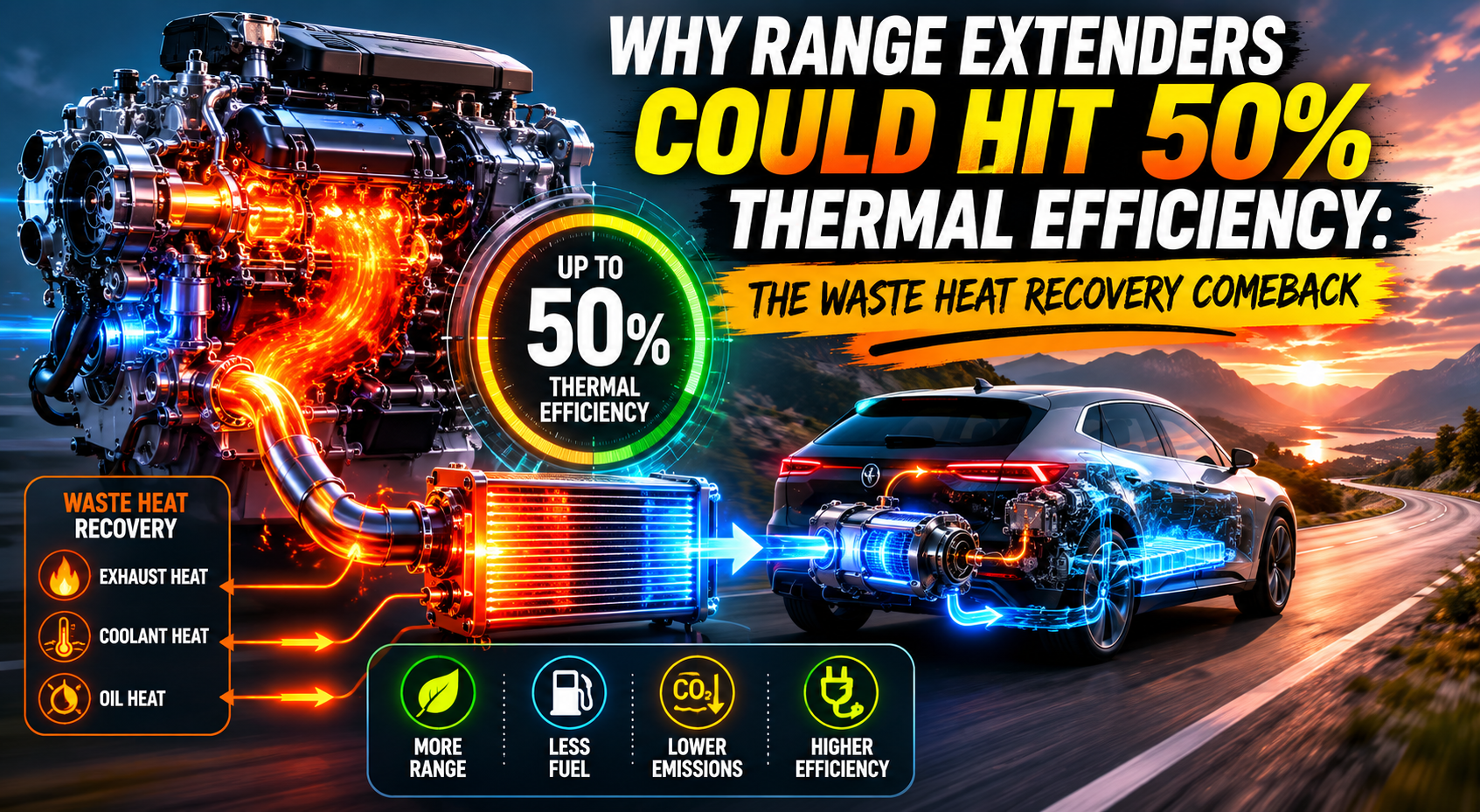
Why Range Extenders Could Hit 50% Thermal Efficiency: The Waste Heat Recovery Comeback
Internal combustion engines waste roughly 60% of the energy they consume — most of it as heat dumped into the exhaust and the coolant. For a century, that loss was accepted as a law of physics. It was not. New series-hybrid architectures, combined with Organic Rankine Cycles and thermoelectric generators, are quietly pushing engine efficiency from 30% to 50%. Nissan has already demonstrated it in the lab. Here is what it means — and why it changes the math on e-fuels.
I. The thermodynamic embarrassment of the combustion engine
Pour the contents of a one-litre fuel can into a modern petrol engine, and roughly two-thirds of that liquid will never move the car. It will be lost as heat. Some of it leaves through the tailpipe at 600 to 800 degrees Celsius. Some of it leaves through the cooling system at 90 to 110 degrees. A small remainder dissipates through friction, oil, and radiated warmth from the engine block. The fraction that actually reaches the wheels — what engineers call brake thermal efficiency — is typically 25 to 35%.
This has been the central thermodynamic fact of the automobile since Karl Benz’s first Patent-Motorwagen in 1886. It is the reason internal combustion engines have always felt slightly absurd: a complex, expensive, finely machined device whose primary output is, statistically speaking, heat. The motion of the vehicle is, in a sense, a byproduct.
Source: BMW EfficientDynamics program data, multiple academic reviews. Figures vary slightly by engine type and operating regime, but the central insight holds: in a typical car, around 60% of fuel energy leaves as recoverable heat.
That two-thirds loss is what makes the comparison to electric motors so brutal. A modern electric motor converts 85 to 95% of the electrical energy it receives into mechanical work at the wheels. For the same number of joules consumed by the powertrain itself, an EV does roughly three times more useful work than a combustion car. This is the central technical reason electric vehicles have become the default policy answer to transportation decarbonization.
But the comparison hides something important. The 85-95% figure is the efficiency of the motor itself, not of the entire chain from primary energy source to wheel. Once you add grid losses, battery charging and discharging, and especially the carbon footprint of generating the electricity in the first place — particularly in countries still running coal or natural gas plants — the gap closes considerably.
Which raises an old engineering question with new urgency: what if we could recover that 60% of wasted heat? Not all of it. Even half. Even a third. What would it do to the equation?
The answer, as it turns out, is: rather a lot. And several manufacturers — Nissan, BMW, Honda, Lotus, Mahle — have spent the past two decades quietly proving it.
II. The three technologies that recover waste heat
Before going further, a vocabulary clarification. The technical literature distinguishes three main families of waste heat recovery (WHR) systems for automotive applications. They are not mutually exclusive — modern designs often combine two or all three — but they work on fundamentally different physical principles.
1. Thermoelectric generators (TEG): the space-age option
A thermoelectric generator converts a temperature difference directly into electricity via the Seebeck effect, discovered in 1821. When two dissimilar semiconductor materials are joined at two junctions held at different temperatures, an electric voltage develops across the circuit. There are no moving parts, no fluids, no turbines. Just solid-state physics.
NASA has used thermoelectric generators to power deep-space probes for sixty years. The Voyager spacecraft, Curiosity, and Perseverance all rely on plutonium-238 RTGs (radioisotope thermoelectric generators) to convert nuclear decay heat into electricity. The technology is mature, reliable, and inherently robust — but it has historically suffered from low conversion efficiency, typically 3 to 8%, which is why it took so long to migrate from spacecraft to cars.
BMW began serious automotive TEG research in 2005 as part of its EfficientDynamics initiative. By 2009, BMW had integrated a TEG into the exhaust gas recirculation (EGR) cooler of a Series 5 V8 diesel. The unit harvested up to 250 watts — roughly half the onboard electrical demand of the vehicle — and translated to approximately 2% fuel savings. Later prototypes on Series 5 and X6 demonstrated outputs up to 600 watts. A US Department of Energy program with Gentherm and BMW eventually reached 1 to 2 kilowatts on medium and heavy-duty vehicles.
The numbers are modest, but the principle is sound: every watt extracted from the exhaust stream is a watt that the alternator does not need to take from the crankshaft. And in series-hybrid configurations, that watt goes directly into the battery rather than into a 12-volt accessory system, where it has more strategic value.
2. The Organic Rankine Cycle (ORC): a miniature power plant under the bonnet
The ORC is conceptually identical to the steam engine that drove the industrial revolution, with one critical substitution. Instead of using water — which requires very high temperatures to vaporize — an ORC uses an organic working fluid: a hydrocarbon, a refrigerant, or a silicone-based oil, chosen for its low boiling point. This allows the cycle to operate effectively from heat sources as low as 80 to 100 degrees Celsius, exactly the temperature of an engine coolant circuit.
The cycle works in four stages. The working fluid is pumped at high pressure through a heat exchanger placed on the exhaust manifold (or the coolant return). It vaporizes. The hot, high-pressure vapour expands through a turbine or a scroll expander, producing mechanical work. The mechanical work drives a small electric generator. The vapour, now cooled and at lower pressure, passes through a condenser where it returns to liquid form, ready to be pumped back to the heat exchanger.
The result, in practical automotive testing, is a conversion efficiency of 5 to 12% of the recovered heat into electricity. Higher than TEGs by a factor of two or three. The cost: more moving parts, additional fluid management, and roughly 15 to 25 kilograms of added vehicle weight.
BMW’s Turbosteamer project, demonstrated publicly in 2005 and refined repeatedly until 2017, claimed up to 15% improvement in overall engine performance on certain operating regimes — primarily highway cruising at constant speed. Honda announced a comparable system in 2008, also for hybrid applications. Cummins built a commercial ORC product for heavy-duty diesel trucks. Volvo, Daimler, and Volkswagen all ran serious development programs.
None of these projects reached mass production in passenger cars. The reason was almost always the same: the cycle works brilliantly when the engine operates near a steady-state regime, but degrades sharply under the constant load variations of normal driving. A car accelerating, decelerating, idling, climbing, and braking is the worst possible heat source for an ORC. The working fluid does not have time to stabilize, the heat exchanger lags the engine, and the conversion efficiency drops well below its theoretical potential.
Which brings us to the architecture that finally makes this work.
3. The micro-turbine: a niche but credible alternative
The third option, less developed in mass production but technically interesting, is the micro gas turbine. Small turbines running at constant load have been demonstrated as range extenders with thermal efficiencies up to 35% using recuperators, comparable to a well-designed piston engine but with dramatically reduced moving parts, vibration, and noise. Capstone, Bladon Jets, and Wrightspeed have all explored this avenue for buses and trucks. Walmart’s experimental Advanced Vehicle Experience tractor used a Capstone microturbine.
For passenger cars, the slow transient response of turbines is a problem in conventional architectures. In a series hybrid where the turbine only generates electricity at a fixed operating point, that limitation evaporates. Several Chinese EREV startups have flirted with the idea. None has yet brought it to volume production. The technology remains, for now, an interesting outlier rather than a mainstream solution.
III. Why the EREV architecture changes everything
The fundamental problem with WHR in conventional cars is that the engine is mechanically coupled to the wheels. This means the engine has to follow the driver’s foot. It revs up when the driver accelerates, drops to idle at a red light, climbs to high RPM on a motorway slip road. The exhaust temperature and mass flow rate vary constantly. WHR systems, which are essentially miniature power plants, work best at steady state. Forcing them onto a transient heat source is like running a thermal power station on a fluctuating fuel feed: theoretically possible, practically painful.
An EREV — Extended Range Electric Vehicle, also called a series hybrid — breaks that coupling. The wheels are driven entirely by an electric motor, which draws from the battery. The combustion engine has only one job: to drive a generator that recharges the battery when needed. The engine has no mechanical connection to the wheels at all.
This means the engine can run at one single, optimal operating point. A specific RPM. A specific load. A specific air-fuel ratio. The most efficient point on its entire operating map. For hours, if necessary.
In a conventional car, the engine has to be good at a thousand operating points. In an EREV, it only has to be excellent at one. That single freedom is what unlocks 50% thermal efficiency.
This is exactly the regime in which ORC systems, TEGs, and high-compression-ratio combustion all thrive. The exhaust temperature is stable. The mass flow is stable. The thermal exchangers reach steady state and stay there. The lean-combustion strategies that improve fundamental engine efficiency, but require careful calibration, become straightforward to deploy because there is no transient to manage.
This is not a theoretical claim. Nissan has demonstrated it.
IV. The Nissan e-Power demonstration: 50% in the lab
On 26 February 2021, Nissan published a quiet press release that should have made far more noise than it did. The company announced that its next-generation e-Power series hybrid system had achieved a thermal efficiency of 50% in laboratory testing — a figure normally associated with Formula 1 power units, not road cars.
The headline number broke the implicit ceiling of the spark-ignition engine. The previous record was Toyota’s Dynamic Force family, deployed in the fourth-generation Prius, which reached 41% thermal efficiency in 2018. Nissan’s e-Power had now beaten that by nine percentage points — a margin that, in engine engineering, is enormous.
The achievement combined three engineering choices, in cumulative layers:
First, lean combustion via the STARC concept. STARC stands for Strong, Tumble and Appropriately stretched Robust ignition Channel. The idea is to create a vigorous, controlled vortex of air-fuel mixture inside the combustion chamber, combined with an unusually long and intense ignition discharge. This allows the engine to burn a much leaner mixture — lambda equals 2, meaning twice as much air as the stoichiometric ratio — without misfire. Combustion of a lean mixture is fundamentally more efficient because the excess air absorbs less heat per unit of fuel. Nissan reported 46% thermal efficiency from lean combustion alone, with a multi-cylinder test engine.
Second, fixed-point operation. By restricting the engine to a single RPM and load — the configuration unique to series hybrid architectures — Nissan eliminated all the calibration compromises that normally limit lean combustion. The engine could be tuned for one specific operating point and optimized exclusively for that point. This brought the figure from 46% to the threshold of 50%.
Third, waste heat recovery technology. Nissan was careful not to specify which WHR approach they used — likely a combination of EGR coolant heat recovery, possibly with an ORC bottoming cycle. What they did say is that the WHR component was essential to crossing the 50% threshold.
The Nissan result was a laboratory achievement, not yet commercial. The current e-Power production engines (sold in Japan since 2016 in the Note, and now in Europe in the Qashqai e-Power and X-Trail e-Power) operate around 40 to 42% efficiency — still excellent, but below the 50% target. The next generation, projected for 2026-2028 model years, is expected to bring the lab figure to the showroom.
What matters for our story is that the architecture works. The pairing of series-hybrid layout, lean combustion, and waste heat recovery is no longer speculative. It has been demonstrated. It is now a question of industrialization, cost reduction, and market deployment.
V. What this means for the Horse C15 and Renault’s 2028 EREV
Recall, from our previous analysis, that Renault announced in March 2026 the deployment of EREV variants of the Mégane and Scenic platforms by 2028, powered by the Horse C15 — a 1.5-litre four-cylinder generator engine developed by Horse Powertrain. The announcement gave a combined autonomy of 1,400 kilometres but did not specify the engine’s thermal efficiency.
It is worth doing the engineering math.
The Horse H12 already achieves 44.2% thermal efficiency in a passenger-car configuration, where the engine has to respond to transients. If Horse applies the same combustion technology — high compression ratio, exhaust gas recirculation, optimized friction — to the C15 in a fixed-point series hybrid configuration, it should reach at least 45 to 47% thermal efficiency on basic principles alone, simply by removing the transient calibration constraints. That puts Horse roughly where Toyota’s Dynamic Force engines were, but in a generator-only application.
Add a properly integrated WHR system — likely an ORC on the exhaust, possibly combined with EGR coolant heat recovery — and the C15 could plausibly reach 48 to 50% thermal efficiency, matching Nissan’s lab result. For a generator engine running predominantly at one operating point, this is not optimistic. It is the logical engineering outcome of applying known technologies to an architecture designed for them.
What this means in practical fuel consumption terms: a Mégane EREV with a C15 generator at 48% thermal efficiency could plausibly consume around 3.5 litres per 100 kilometres in extended-range mode, compared to roughly 5 to 6 litres for a conventional petrol Mégane. Over a typical EREV usage profile — 80% battery driving, 20% generator driving — average fuel consumption could fall below 1 litre per 100 kilometres on the WLTP cycle.
This is the figure that should make the e-fuels industry sit up. Because at 1 litre per 100 kilometres, even an e-fuel costing three euros per litre adds only three euros to a 100-kilometre trip. That is roughly the cost of a coffee. The economic objection to e-fuels — that they are too expensive for mass-market adoption — dissolves at that consumption level.
VI. The compounded effect: from primary energy to wheel
To properly understand the strategic significance of 50%-efficient EREVs, we need to widen the analytical frame. Engine thermal efficiency is only one link in a longer chain. What matters, for both economics and carbon accounting, is the full conversion from primary energy source to kinetic energy at the wheel.
For a battery electric vehicle, the chain is typically: power station (around 40 to 60% efficient for combined-cycle gas, 100% for renewables) → grid transmission (around 92%) → charger (around 90%) → battery charging and discharging (around 90% each way) → motor and inverter (around 90%). Multiply through: well-to-wheel efficiency in a gas-powered grid lands around 30 to 35%. In a fully renewable grid, the upstream efficiency disappears as a relevant metric (the energy is free anyway), and the figure reaches around 75 to 80%.
For a conventional combustion vehicle running on petrol, the chain is: refinery (around 90% efficient) → distribution (around 99%) → engine (around 30%). Well-to-wheel: around 25 to 28%. Worse than BEV, but only by a margin of perhaps 10 to 15 percentage points in carbon-intensive grids.
For an EREV running on e-fuels with a 50%-efficient generator, the chain becomes: renewable electricity → electrolyzer (around 70 to 75%) → e-fuel synthesis via Fischer-Tropsch or methanol-to-jet (around 60 to 70%) → fuel distribution (around 99%) → generator engine with WHR (around 50%) → battery (around 90% round trip) → motor (around 92%). Well-to-wheel: around 16 to 20%.
That is lower than BEV. Significantly lower. There is no honest engineering case in which an EREV running on synthetic fuels is more energy-efficient than a battery electric vehicle running on the same renewable electricity. Energy efficiency was never the argument for e-fuels.
The argument is different. It is about infrastructure compatibility, supply chain independence, and behavioural flexibility. An EREV refuels in three minutes at any petrol station, drives 1,400 kilometres without stopping if needed, and shifts the dependency from Chinese batteries to European-made fuel. The energy is more expensive per kilometre. The carbon footprint, with the right hydrogen source, can be near zero. And the user experience matches a conventional car — no range anxiety, no charging logistics, no cold-weather autonomy collapse.
This is, ultimately, why both technologies will coexist. Battery electric vehicles will dominate urban and short-distance use cases where their efficiency advantage is clearest. EREVs will dominate long-distance, rural, and professional use cases where their flexibility advantage is decisive. The 50%-efficient generator engine is what makes the second category economically viable.
VII. The industrial signals to watch
Several developments in 2026 are worth tracking for anyone following this space.
Horse Powertrain’s WHR roadmap
Horse has not publicly disclosed whether the C15 will integrate waste heat recovery in its 2028 launch configuration. However, the company’s published thermal management patents and the close collaboration with Aramco — which has a significant downstream interest in synthetic fuels — suggest WHR is being seriously considered. A series-hybrid architecture without WHR would leave significant efficiency on the table.
Nissan’s e-Power Europe expansion
Nissan brought e-Power to Europe in 2022 with the Qashqai and X-Trail. The current generation, at around 41% thermal efficiency, is already competitive. The next generation — projected for the 2027 facelift cycle — is widely expected to integrate the STARC combustion and WHR upgrades that delivered 50% in the lab.
Chinese EREV escalation
Li Auto, the most profitable Chinese EV startup, has built its entire portfolio on EREV architectures. The company is investing heavily in next-generation generator engines with target efficiencies above 45%. Xiaomi, BYD, Geely, and Changan are all developing competing systems. The Chinese supply chain is currently the global leader in EREV component cost reduction.
Mahle Powertrain’s “dedicated range extender” business
Mahle, the German powertrain specialist, has built a substantial consulting and engineering practice helping Chinese and European OEMs design dedicated range-extender engines. The company’s Mike Bassett has publicly indicated that next-generation range extenders combine clean-sheet engine design with hybrid integration — moving well beyond the older approach of adapting existing engines. A nine-month concept-to-prototype timeline is now common in this segment.
The Walmart pickup test case
In an underreported development, Scout Motors, Volkswagen Group’s revived American outdoor brand, confirmed that the majority of preorders for its forthcoming SUV and pickup are for the EREV “Harvester” variant, not the pure battery electric version. This is the first hard market signal that American consumers — historically skeptical of electrification — find EREVs more acceptable than pure EVs for long-distance and towing use.
VIII. What remains uncertain
Two engineering reservations deserve mention before concluding.
WHR systems add cost, weight and complexity. The ORC subsystem in particular adds roughly 15 to 25 kilograms, requires a dedicated working fluid loop, and introduces maintenance considerations that did not exist before. For a passenger car, this is a non-trivial business case. The threshold for commercial deployment depends on the value placed on the few percentage points of additional efficiency, which in turn depends on fuel prices, carbon regulations, and consumer willingness to pay.
Real-world efficiency rarely matches laboratory peak. Nissan’s 50% figure was achieved on a test bench under controlled conditions. Real driving introduces cold starts, partial-load operation when the battery is charging slowly, ambient temperature variations, and NVH constraints that may force the engine to vary its operating point even in a generator configuration. The production figure will probably be 2 to 4 percentage points lower than the lab figure. That still puts a well-designed EREV generator engine somewhere around 46 to 48% in actual use — still extraordinary by historical standards.
A third reservation is more strategic than technical. If WHR can lift EREV efficiency to 50%, it can also lift conventional ICE efficiency, just less so. The convergence between optimized hybrid combustion engines and pure battery electric vehicles is happening on both sides. EVs are getting more efficient through better motor controls, lighter batteries, and heat-pump cabin heating. Combustion engines are getting more efficient through WHR and lean combustion. The performance gap between the two architectures, in well-to-wheel terms, will narrow over the next decade — but not close. EVs running on renewable electricity will remain the most energy-efficient option for the majority of use cases.
What changes is the size of the niche where EREVs and combustion-on-e-fuels make sense. With 30%-efficient engines and 5 €/L e-fuels, that niche is essentially zero. With 48%-efficient engines and 2.5 €/L e-fuels, it covers somewhere between 20 and 35% of the European new-vehicle market by the early 2030s. That is the prize the industry is chasing.
IX. The strategic conclusion
For a hundred years, the internal combustion engine was a fundamentally wasteful machine. Two-thirds of its fuel energy was lost as heat. This was tolerated because the alternative was either non-existent or impractical, and because liquid fossil fuels were absurdly cheap and energy-dense.
The situation has now shifted on both sides. Battery electric vehicles offer a genuinely more efficient powertrain. Synthetic fuels — when produced from renewable electricity and hydrogen — offer a low-carbon alternative to fossil petrol. Neither alone is the universal answer. Each occupies part of the future mobility landscape.
The series-hybrid EREV architecture, combined with waste heat recovery, is the technology that determines how that landscape is divided. At 30% engine efficiency, EREVs were a niche curiosity. At 50%, they become a credible mainstream option. The difference between those two figures is, almost entirely, the question of whether the wasted heat is recovered.
This is not glamorous technology. There are no flying cars in this story. Just heat exchangers, working fluids, lean combustion strategies, and the patient engineering of converting one form of energy into another with progressively less loss. But this unglamorous work is the foundation on which the European multi-technology mobility system is being built — the system we described in our previous pillar analysis.
The next time you see a press release about a new EREV launch, look past the autonomy figure. Look for the thermal efficiency of the generator engine. If it is below 40%, the system is a transitional product. If it is above 45%, the system is positioning for the 2030s. And if it crosses 50%, with WHR integration, you are looking at one of the quiet engineering breakthroughs that will define the next decade of automotive history.
Waste heat recovery is back. Not as a flashy science project. As the missing link that makes range extenders and e-fuels economically sensible at scale.
Selected sources
- Nissan Motor Corporation, “e-POWER’s internal combustion engine achieves 50% thermal efficiency”, press release, 26 February 2021.
- Hirai, T., Senior Vice-President of Powertrain and EV Engineering at Nissan, interviews 2021–2024.
- BMW Group, “BMW EfficientDynamics — Turbosteamer and Thermoelectric Generator projects”, press release, 28 August 2011.
- Gentherm / BMW / US Department of Energy, “Thermoelectric Waste Heat Recovery Program for Passenger Vehicles”, final report, US DOE OSTI 1337561.
- Karvountzis-Kontakiotis, A. et al., “Organic Rankine Cycle Waste Heat Recovery for Passenger Hybrid Electric Vehicles”, Energies (MDPI), Vol. 13, 4532, 2020.
- Latz, G., “Waste Heat Recovery from Combustion Engines based on the Rankine Cycle”, Chalmers University of Technology, Gothenburg, 2016.
- Lemort, V. et al., “A review of Organic Rankine Cycle (ORC) for vehicle waste heat recovery”, various sources via IntechOpen, 2018.
- Mahle Powertrain, interview with Mike Bassett, Automotive Manufacturing Solutions, 12 August 2025.
- Horse Powertrain communications on H12 Concept and C15 generator engine, February and March 2026.
- Renault Group, “futuREady 2026–2030 strategic plan”, 10 March 2026.
- Scout Motors / Volkswagen Group, communications on Harvester EREV variant pre-orders, 2025–2026.