

3.3L/100km on Renewable Fuel +
46 Mt of White Hydrogen in Lorraine:
The E-Fuel Revolution Has Begun
Horse H12 + Repsol Nexa 95 · REGALOR II confirms Lorraine deposit · What it means for e-fuel prices
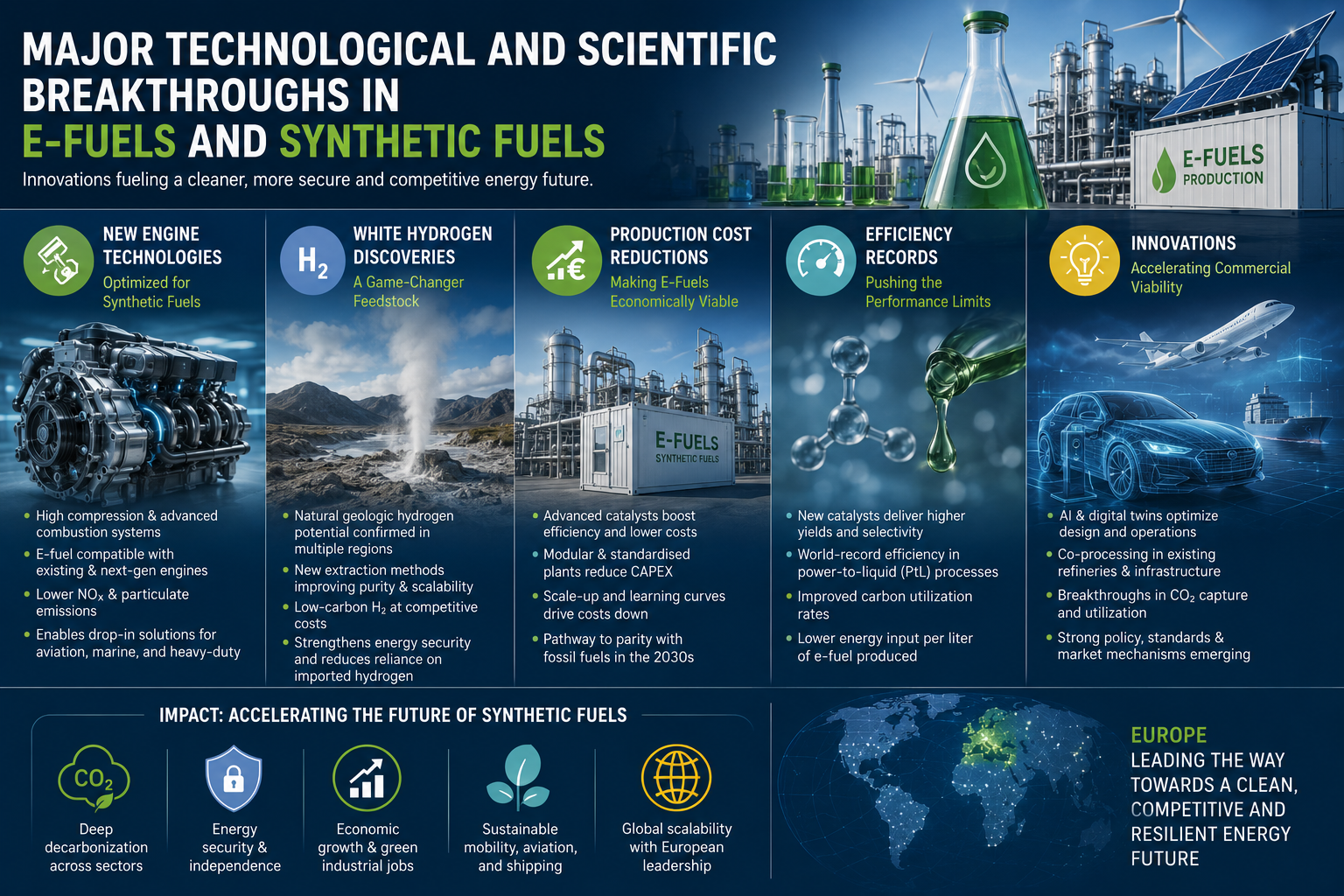
Two breakthroughs in the space of a few months are quietly reshaping the future of e-fuels. First: a petrol engine consuming just 3.3 litres per 100km on 100% renewable fuel — tested on real roads in a Dacia Duster. Second: the world’s largest known natural hydrogen deposit, confirmed in Lorraine (France), just a few dozen kilometres from Luxembourg and Belgium. Together, these two developments could fundamentally change the economics of synthetic fuels — and accelerate the moment when e-fuels become genuinely affordable for everyday drivers.
Part 1 — The Horse H12: A Petrol Engine That Consumes 3.3L/100km on Renewable Fuel
In early 2026, a remarkable engineering feat went largely unnoticed in mainstream media. Horse Powertrain — a joint venture between Renault, Geely and Aramco — unveiled the H12 Concept: a three-cylinder petrol engine consuming less than 3.3 litres per 100km in WLTP combined cycle.
This is not a laboratory prototype. It was tested in real-world conditions on a Dacia Duster, driving between Valladolid and Móstoles in Spain. And crucially, it ran on Repsol’s Nexa 95 — a 100% renewable fuel produced from industrial organic residues: used cooking oils, animal fats and agricultural by-products, with no trace of fossil petroleum.

How Did They Achieve This?
The Horse H12 starts from a familiar base — the three-cylinder HR12 engine block from the Renault-Nissan alliance — but is deeply reconfigured with four key innovations:
2. Advanced EGR (Exhaust Gas Recirculation) — recirculates exhaust gases back into the combustion chamber, reducing pumping losses and improving thermal efficiency.
3. Optimised turbocharger system — delivers the right amount of air at the right pressure for each operating condition, eliminating wasted energy.
4. Advanced ignition system — precise control of combustion timing optimised for the Nexa 95 renewable fuel’s specific octane rating (95 RON).
The Fuel: Repsol Nexa 95 — 100% Renewable, No Fossil Petroleum
The engine efficiency story cannot be told without its partner fuel. Repsol’s Nexa 95 is a 100% renewable petrol produced from industrial organic residues — used cooking oil, animal fats and agricultural by-products — with an octane rating of 95, making it compatible with all existing petrol engines without modification.
Industrial production of Nexa 95 began in October 2025 at Repsol’s Tarragona plant. A new unit is expected at Puertollano in 2026, and a synthetic fuels project is being prepared at Bilbao. For now, distribution is limited to around 30 service stations in Spain — a significant practical limitation at this stage.
Repsol Nexa 95 is currently available at approximately 30 service stations in Spain only. The Horse H12 is a demonstrator — not yet in mass production. Horse Powertrain claims production capacity of ~5 million engines/year if commercial orders follow, but no launch date has been confirmed. Source: motorsactu.com · voituremalin.com · Feb.–May 2026.
Part 2 — The Lorraine White Hydrogen Deposit: 46 Million Tonnes Confirmed
While the Horse H12 addresses the efficiency side of e-fuels, an equally significant development is happening underground — in the Lorraine region of northeastern France, less than 50 kilometres from the Luxembourg and Belgian borders.


“Here in Moselle, the subsoil is part of our history. Tomorrow, it can become a strategic asset for our energy sovereignty and industrial future.”
Franck Leroy — President, Grand Est Region France 24 · January 27, 2026 — official statementHow Was the Deposit Discovered?
Philippe De Donato and Jacques Pironon, research directors at the GeoRessources laboratory of the University of Lorraine, are the scientists behind this discovery. Their initial project, REGALOR, aimed to study methane resources in the region. Using an innovative probe — the SysMoG, capable of detecting hydrogen dissolved in groundwater at great depths — they made an unexpected finding: exceptionally high concentrations of natural hydrogen.
At Pontpierre, some 40 kilometres east of Metz, a 41-metre drilling platform arrived from Austria in January 2026. The drilling rods reached 2,600 metres depth within the first week, with the objective of reaching 4,000 metres depth by February 2026, searching for white or native hydrogen dissolved naturally in underground water.
White Hydrogen vs Green Hydrogen — What’s the Difference?
White (natural) hydrogen — already present in the subsoil, formed by natural geological reactions over millions of years. If exploitable commercially, estimated cost: €0.50–1/kg — potentially 4 to 8 times cheaper than green hydrogen.
The e-fuel connection: Green hydrogen is the most expensive component in PtL (Power-to-Liquid) e-fuel production — accounting for 50–70% of the final cost. If white hydrogen from Lorraine can replace or supplement green hydrogen at €0.50–1/kg instead of €4–8/kg, the impact on e-fuel production costs would be dramatic.
Part 3 — What Does This Mean for E-Fuel Prices?
Today, e-fuels produced via Power-to-Liquid cost between €5 and €15 per litre at the pump — 3 to 10 times more expensive than conventional petrol. The main cost driver is green hydrogen. If the Lorraine white hydrogen deposit proves commercially exploitable, it could transform the economics of synthetic fuel production in Europe.
White hydrogen extracted from the Lorraine deposit could cost a fraction of electrolytic green hydrogen, eliminating the biggest production cost bottleneck for PtL e-fuels.
If hydrogen costs fall by 80%, e-fuel production costs could drop proportionally, bringing synthetic fuels into price competition with conventional fossil fuels at the pump.
Combined with the Horse H12 engine efficiency (3.3L/100km), affordable e-fuels would make synthetic fuel motoring genuinely competitive with battery electric vehicles on total cost of use.
The Combined Vision: What 2030–2035 Could Look Like
Taken separately, both the Horse H12 and the Lorraine white hydrogen are interesting developments. Taken together, they sketch a plausible — if optimistic — scenario for affordable e-fuel mobility in Europe within a decade.
Step 2 (2028–2030): First white hydrogen extraction begins. Hydrogen cost falls toward €1–2/kg in the Grand Est/Lorraine region. PtL e-fuel producers in the region benefit from cheaper feedstock.
Step 3 (2030–2032): Horse H12-type engines enter mass production (Horse Powertrain: ~5M engines/year capacity). Renault, Dacia, Nissan vehicles certified for 100% renewable fuel. Repsol Nexa-type fuels available across Europe via ReFuelEU mandate.
Step 4 (2032–2035): E-fuel price falls to €2–4/L at the pump. Combined with 3.3L/100km efficiency = cost per kilometre competitive with BEV. The EU 2035 e-fuel ICE exemption becomes practically meaningful for everyday drivers.
“Natural hydrogen could be much more abundant than we thought. This abundance could not only transform our energy approach but also encourage research and the development of new extraction technologies.”
Dr. Jacques Pironon — Research Director, GeoRessources Laboratory, University of Lorraine / CNRS davidson.fr · 2025 — scientific source🔗 Also explore: syntheticfuels.ai — global market & technology · h2blanc.eu — white hydrogen Europe · hydrogen.lu — Luxembourg H₂ hub
Horse H12 engine: motorsactu.com (April 2026) · voituremalin.com (February 2026) · wash-wash.fr (February 2026) · Horse Powertrain official communications · Repsol Nexa 95 product information.
Lorraine white hydrogen: France 24 (27/01/2026) · AFP · FranceTransactions.com (25/03/2026) · davidson.fr (2025) · le-gaz.fr (June–July 2025) · CNRS/GeoRessources · Journal Officiel FR (28/01/2026) — “Trois Évêchés” permit · Française de l’Énergie (FDE) official communications · REGALOR II project.
Pipeline infrastructure: creos-net.lu (HY4Link/mosaHYc) — official.
E-fuel price context: MarketsandMarkets · Precedence Research · Transport & Environment.
Disclaimer: Documentary portal. All data from cited sources. Price projections are analytical estimates under major scientific reservations — natural hydrogen is an emerging technology. Only Mali produces natural hydrogen commercially. Not investment advice. BESS Energie SRL · BCE 0698.949.732 · Heusy (Verviers, Belgium) · info@bess.be · e-fuels.ai