
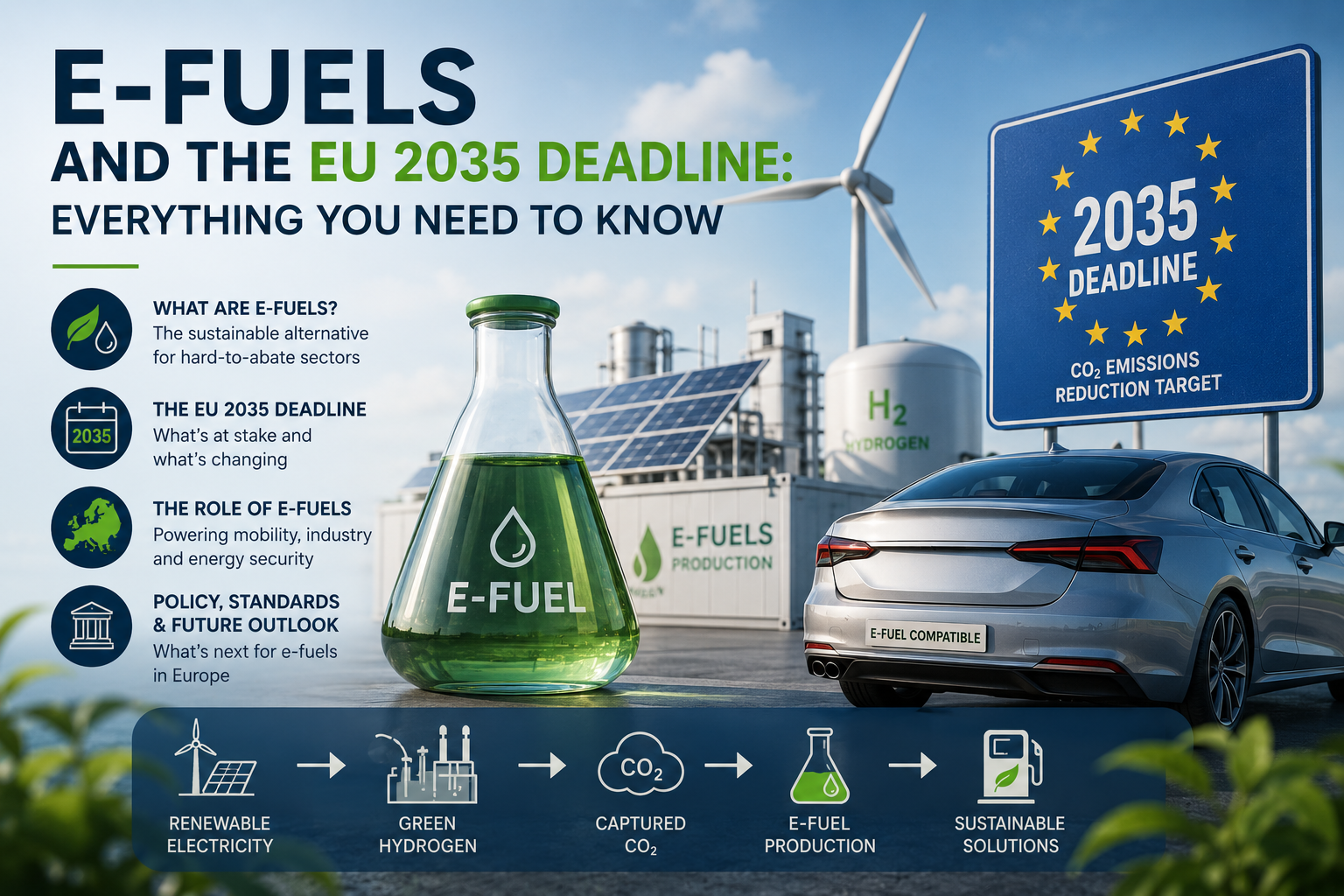

E-fuels are at the centre of Europe’s most debated energy policy. The EU 2035 ICE ban, the ReFuelEU Aviation mandates, FuelEU Maritime and the US Inflation Reduction Act are reshaping the entire transport and energy landscape. This guide explains what e-fuels are, why EU regulation makes them indispensable, and what the 2035 deadline really means for drivers, airlines, shipowners and industry.
What Are E-Fuels? The Simple Explanation
E-fuels (electrofuels) are synthetic fuels produced from renewable electricity + green hydrogen + captured CO₂. The process — called Power-to-Liquid (PtL) — creates liquid hydrocarbons chemically identical to conventional petrol, diesel or jet fuel.
The critical difference: the carbon used comes from CO₂ already in the atmosphere, not from underground fossil deposits. When the e-fuel is burned, it releases only the CO₂ that was previously captured — making it carbon-neutral in a closed loop, when powered by renewable electricity.

The EU 2035 ICE Ban — And the E-Fuel Exemption
In July 2021, the European Commission proposed banning the sale of new petrol and diesel cars from 2035 as part of the Fit for 55 package. After intense lobbying — led notably by Germany, Porsche and the eFuel Alliance — a critical compromise was reached in March 2023.
New internal combustion engine (ICE) vehicles can continue to be sold after 2035 — but only if they run exclusively on certified synthetic e-fuels. The European Commission committed to creating a specific vehicle sub-category for “e-fuel only” cars under the type-approval regulation.
You will be able to buy a new ICE car after 2035 — if it is certified to run only on e-fuels. Existing ICE cars are not affected at all by the 2035 regulation.
Porsche, BMW, Mercedes and others can continue making ICE engines post-2035 — if those engines are e-fuel certified. Major investment in e-fuel compatibility ongoing.
The methodology to certify “e-fuel only” vehicles under type-approval is still being finalised by the European Commission. Practical implementation is complex.
European Parliament · European Council · March 2023 compromise agreement — official legislative documents. Not investment advice.


ReFuelEU Aviation — The SAF Mandate Explained
ReFuelEU Aviation (EU Regulation 2023/2405) entered into force on 1 January 2024. It applies to all flights departing from EU airports — regardless of the airline’s nationality. Fuel suppliers must blend increasing proportions of Sustainable Aviation Fuel (SAF) into conventional jet fuel.
ReFuelEU contains a specific sub-mandate for Power-to-Liquid synthetic fuels — not just any SAF. This is critical: HEFA (from waste oils) counts as SAF but not as synthetic. The sub-mandate ensures a guaranteed market for PtL/e-fuels regardless of HEFA availability. By 2050, 35% of all EU aviation fuel must be synthetic — equivalent to tens of millions of tonnes annually.
Which Sectors Need E-Fuels Most?
Cannot be electrified. ReFuelEU mandates. SAF market $25.6B by 2030. IATA: 65% of decarbonisation via SAF by 2050.
Deep-sea shipping impossible to electrify. FuelEU Maritime: -2% GHG 2025 → -80% 2050. E-methanol, e-ammonia lead.
200M+ ICE vehicles in EU in 2035. E-fuel exemption from ICE ban. Porsche, BMW, Mercedes investing heavily.
Steel, chemicals, high-temperature processes. E-hydrogen, e-methanol replace fossil feedstocks. ArcelorMittal, Thyssenkrupp.

Key Regulatory Milestones — Timeline
Commission proposes 2035 ban on new ICE vehicles + first SAF mandates for aviation. Start of the e-fuels debate in EU institutions.
EU Regulation 2023/2405 officially adopted. SAF blending mandates binding from 1 January 2024. Sub-mandate for synthetic (PtL) fuels confirmed. Source: Official Journal of the EU.
After Germany, Italy, Poland and Czech Republic block the original proposal, the European Council agrees: ICE vehicles running exclusively on certified e-fuels are exempt from the 2035 ban. Porsche, BMW and eFuel Alliance declare victory. Source: European Parliament · European Council.
The IRA introduces production tax credits of up to $3/gallon for SAF and major investment tax credits for PtL facilities. Triggers $100B+ in US e-fuel investment announcements. Source: US Congress · IRS.
Regulation applies to ships ≥5,000 GT calling at EU ports. GHG intensity reductions: -2% (2025) → -6% (2030) → -14.5% (2035) → -80% (2050). E-methanol and e-ammonia are the main e-fuel solutions. Source: European Maritime Safety Agency (EMSA).
Shell’s Hamburg Power-to-Liquids plant — Europe’s first at commercial scale — begins operations. Marks the transition from pilot to commercial e-fuel production in the EU. Source: Shell IR · February 2025.
All fuel suppliers at EU airports must blend minimum 2% SAF from 1 January 2025. First year of ReFuelEU implementation. Non-compliance: financial penalties proportional to the shortfall. Source: EASA · European Commission.
Global Policy Comparison
| Policy | Scope | 2025 | 2030 | 2050 |
|---|---|---|---|---|
| 🇪🇺 ReFuelEU Aviation | All EU airport departures | 2% SAF | 6% · 1.2% synthetic | 70% · 35% synthetic |
| 🇬🇧 UK SAF Mandate | UK aviation fuel suppliers | 2% | 9.5% · 0.5% PtL | 75% |
| 🇺🇸 US SAF Grand Challenge | US domestic SAF production | ~0.5 Bn gal | 3 Bn gallons | 100% aviation |
| 🇯🇵 Japan SAF Target | Japanese aviation | — | 10% SAF | — |
| 🌍 IMO Maritime | International shipping | — | -40% CO₂/transport work | Net-zero by 2050 |
🔗 Also explore: syntheticfuels.ai — technology & market · hydrogen.lu — Luxembourg hydrogen hub · syntheticfuelsmarket.com — market data
European Commission · ReFuelEU Aviation (EU Regulation 2023/2405) · Official Journal of the EU · European Parliament March 2023 compromise · European Council · EASA (European Union Aviation Safety Agency) · EMSA (European Maritime Safety Agency) · IATA · ACEA (European Automobile Manufacturers’ Association) · US Congress IRA (Inflation Reduction Act, August 2022) · US IRS · UK Department for Transport · Shell IR (February 2025) · efuel-alliance.eu · IMO (International Maritime Organization).
Disclaimer: Documentary portal. All regulatory data from official sources. Not legal or investment advice. Regulations subject to change — always verify with official sources. BESS Energie SRL · BCE 0698.949.732 · Heusy (Verviers, Belgium) · info@bess.be · e-fuels.ai