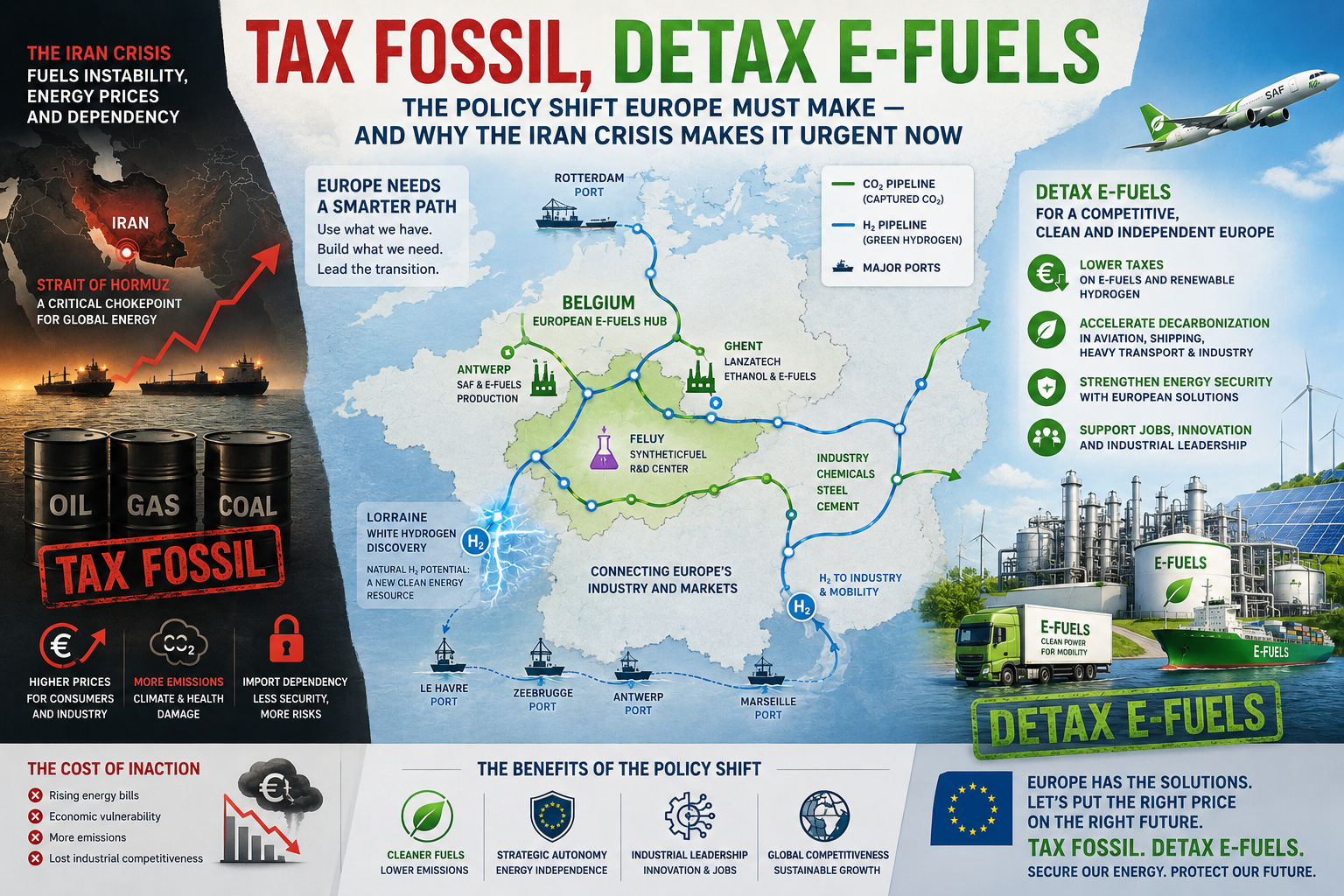
Tax Fossil, Detax E-Fuels: The Policy Shift Europe Must Make — and Why the Iran Crisis Makes It Urgent Now

European policy e-fuels tax reform fossil fuel surcharge energy security Iran

Tax Fossil, Detax E-Fuels:
The Policy Shift Europe Must Make —
and Why the Iran Crisis Makes It Urgent Now

🇪🇺 EU Regulation · May 17, 2026 · e-fuels.ai

📅 May 17, 2026⏱ 8 min read✍️ e-fuels.ai · BESS Energie SRL

The case for differentiating the taxation of e-fuels from fossil fuels has never been stronger — or more urgent. E-fuels currently cost 3 to 8 times more than fossil equivalents, primarily because they bear the same fuel taxes as the fossil fuels they are designed to replace. Meanwhile, the geopolitical situation around Iran is tightening energy supply routes, oil price volatility is back, and Europe’s energy import dependency remains structurally dangerous. A fiscal instrument — tax fossil fuels more, tax e-fuels less — could bridge the cost gap faster than any subsidy programme. Here is the case for this policy shift, and why it is becoming a political necessity.

×3–8E-fuels more expensive than fossil equivalent today at the pump* EASA · eFuel Alliance — official/research
85%European fossil fuel import dependency for transport · 2025* European Commission — official
2035ICE e-fuel exemption deadline · EU · fiscal framework needed urgently* European Parliament March 2023 — official

The Cost Problem — Why E-Fuels Are Still 3–8× More Expensive

The primary reason e-fuels cost more than fossil fuels is not technology — it is the cost of green hydrogen and the absence of carbon pricing that would level the playing field. But a secondary reason is equally important: e-fuels pay the same excise taxes as the fossil fuels they replace. In Belgium, petrol excise duty is approximately €0.60/litre. An e-fuel producer selling at €3–8/litre faces the same excise burden as a fossil fuel producer selling at €0.70/litre. This makes the effective price premium of e-fuels even larger for the end consumer.

💡 The simple fiscal fix: If EU member states were permitted to apply a zero or reduced excise duty on certified e-fuels while simultaneously raising excise duty on fossil fuels, the price differential could be halved overnight — without a single euro of direct subsidy. The EU Energy Taxation Directive (ETD), revised in 2024, already allows member states flexibility on minimum tax rates for certain fuels. A specific e-fuels carve-out would be legally feasible within the existing framework. The political will is what is missing.

The Iran Factor — Why Energy Security Changes the Calculus

The ongoing tensions around Iran in 2025–2026 have reminded European policymakers of a structural vulnerability: Europe imports approximately 85% of its transport fuel feedstocks from regions that are either geopolitically unstable or actively hostile to European interests. The Strait of Hormuz — through which approximately 20% of global oil trade flows — remains a potential chokepoint.

⚠️ The energy sovereignty argument: E-fuels produced from domestic renewable electricity, CO₂ captured from European industrial sources and green hydrogen are — by definition — immune to Middle Eastern geopolitics. A litre of e-kerosene produced at INERATEC’s Frankfurt plant or LanzaTech’s future Ghent facility cannot be subject to an Iranian oil embargo. This is not a climate argument — it is a defence and security argument that resonates across the political spectrum. Note: this analysis reflects the structural energy security argument; specific geopolitical developments are uncertain and not investment advice.
European energy independence clean fuel sovereign production policy
Energy sovereignty: e-fuels produced from European renewable electricity cannot be embargoed · Photo: Unsplash (free license)

The Electric Vehicle Weight Problem — A New Argument for E-Fuels

A growing technical debate is also strengthening the case for e-fuels in road transport. Electric vehicles — particularly large SUVs and commercial vehicles — are significantly heavier than their combustion equivalents, due to battery weight. A typical EV battery weighs 400–800 kg. This creates structural problems: road wear increases with the cube of axle load, bridge weight limits are challenged, and parking garage floors require reinforcement.

💡 The prolongateur d’autonomie / range extender argument: Renault and other manufacturers are actively developing hybrid “range extender” architectures — small, highly efficient combustion engines (like the Horse H12 at 3.3L/100km) that extend EV range without the full weight of a large battery. These engines are perfectly compatible with e-fuels. A range-extender hybrid running on certified e-fuels could offer zero net-carbon mobility without the weight penalties of full BEV — a significant advantage for commercial vehicles, rural users and long-distance travel. This is not a reason to abandon electrification — it is a reason to keep e-fuels in the policy toolkit alongside it.

What Europe Should Do — The Policy Package

Three complementary policy measures would significantly accelerate e-fuels adoption without requiring massive direct subsidies:

1. Excise duty differentiation — zero or reduced excise on certified e-fuels under the EU Energy Taxation Directive. Legally feasible within existing framework.

2. Carbon border adjustment on fossil fuels — extend CBAM to imported fossil transport fuels, raising their effective cost and levelling the playing field with domestically produced e-fuels.

3. E-fuel certification fast-track — simplify and accelerate the certification process for e-fuel producers to access the EU 2035 ICE exemption framework, currently still being developed by the European Commission.

📡 Weekly EU e-fuels policy updates on e-fuels.ai · syntheticfuels.ai · e-saf.ai · synfuels.ai
Sources: EASA reference prices (2024) · eFuel Alliance official · European Commission ETD revision (2024) · European Parliament March 2023 ICE compromise · Renault/Horse Powertrain H12 Concept (February 2026) · ACEA (200M+ ICE vehicles 2035) · Energy security data: European Commission import dependency statistics. Note on Iran: geopolitical analysis reflects structural energy security argument only — not a prediction of specific events. Documentary portal — not investment advice. BESS Energie SRL · BCE 0698.949.732 · Heusy (Verviers, Belgium)

Leave a Reply

Your email address will not be published. Required fields are marked *